
Written by Chris Williams, CEO & Founder, Timeless AI™ · Published 29 June 2026 · Updated 3 October 2026

How to choose the best digital twin app in 2026: 17 AI twin platforms compared
We read the published terms and price pages of the AI twin, clone and avatar platforms people compare most, and judged each one on the job it was built to do. The answer depends on whether you want a face for a video, a bot for an audience, or a twin of you that works as you and passes to the people you name.
The best digital twin app for a person in 2026 depends on the job. HeyGen and Synthesia make marketing and training videos, Delphi and Uare.ai make creator chat clones, and Timeless AI™ Twin, from Idy®, answers as you on your website, through an API and inside AI assistants, then passes to the executor you name under Executor Lock™.
A personal digital twin is judged on five things, which are fidelity, ownership, governance, voice and longevity. Most comparison pages stop at the first one, because a smooth demo is easy to show and a contract is hard to read, so we read the contracts as well. Across 11 AI twin, clone and avatar platforms and more than 90,000 words of published terms, not one says what happens to your clone, your account or your earnings when you die, and five of the 11 reserve the right to close accounts that go quiet, which is exactly what an account looks like after its owner dies.
That gap matters more every month, because twins are moving from novelty to income. In January 2026 the creator Khaby Lame signed a deal, reported at up to $975 million, granting a Hong Kong-based company rights to an AI twin of himself (Black Enterprise, September 16, 2026). Twin1 raised a $20 million seed round in August 2026 to build twins of individual lawyers for firms such as Linklaters and Dechert (Yahoo Finance, August 22, 2026), and Twincafe launched shareable expert twins in India on September 30, 2026 (The Tribune, September 30, 2026). A twin of you is becoming an asset, and an asset needs an owner, a price and a plan for what happens next.
What is the best digital twin app for a person in 2026?
The best digital twin app for a person in 2026 is the one built for the job you need done, and the quick picks below match each job to the platform built for it. Every price is in US dollars a month unless stated, as published on the platform's own price page when we checked on October 1 or 2, 2026. Full verdicts, the master table and the contract findings follow.
Your job | Best pick | Why |
|---|---|---|
A twin of you that answers clients as you and passes to your executor | Timeless AI™ Twin ($59.99 a month with Timeless Pro) | Answers in the first person on your website, through an API and inside AI assistants, you read every conversation, and Executor Lock™ decides what happens when you die |
Turn website visitors into booked clients around the clock | Timeless AI™ Twin | Answers in your words and your own voice at any hour and sends ready visitors to your booking link, with no cut of your fees |
A presenter video for marketing or training | HeyGen (from $29) or Synthesia (from $29) | Built for scripted avatar video at volume |
Real-time video replicas inside your own app | Tavus (from $59) | A developer platform for conversational video |
A premium AI coaching product sold at $1,000 or more a year | BuddyPro ($197 a month on annual billing) or Steno.ai (from $500) | Built for experts selling a high-priced subscription |
An audience question-and-answer clone for a large creator | Delphi (Builder $79) | Built for reach across a big audience |
A chatbot over your company's documents | CustomGPT.ai (from $99) | Answers from files |
Capturing a departing employee's knowledge | Sensay ($500 per knowledge base a year) | Now an offboarding product |
Twins of every lawyer in a firm, held by the firm | Twin1 (enterprise) | Employer-built twins from email and chat |
Fiction and role play | Character.AI ($94.99 a year) | An entertainment platform |
What is a personal digital twin, and how is a twin different from an AI avatar or an AI clone?
A personal digital twin is an AI model of you, built from your memories, knowledge, personality and voice, that answers as you. The term borrows from industry, where a digital twin is a live model of a machine, building or process, and the two share a name and very little else. An industrial twin is judged on sensor accuracy, while a personal twin is judged on whether the twin captures how you reason, what you know and how you sound. People use "AI twin", "AI clone" and "digital twin of yourself" for the same idea, and avatar tools and document bots often borrow the words too.
Personal digital twin (AI twin): an AI version of a real person that speaks in the first person, in that person's words and voice, and answers questions on the person's behalf.
Industrial digital twin: a live software model of a machine, building or process, used in engineering and manufacturing.
AI avatar: a video likeness of a person that reads a script or fronts a conversation, judged mainly on how the face and voice look and sound.
AI clone: a common name for an AI twin, often used by creator platforms.
Persona: the private AI version of you that you build on Timeless AI™ by talking about your life, your work and your values, in your own cloned voice.
Executor Lock™: Idy's patent-pending system of named executors, Trusted Contacts, a verified death report and a sealed snapshot of your Persona.
Product type | What it does | Judged on | Examples |
|---|---|---|---|
Industrial digital twin | Models a machine or process | Sensor accuracy | Factory and engine twins |
AI avatar | Puts a face and voice on a script or a conversation | How real the video looks | HeyGen, Synthesia, Tavus |
Document chatbot | Answers from uploaded files | Search accuracy | CustomGPT.ai, Sensay |
Character chatbot | Plays a character for conversation or fiction | Entertainment | Character.AI |
Creator clone | Answers an audience in a creator's style | Reach and engagement | Delphi, Uare.ai, Coachvox AI, Personify, MyClone |
Premium expert twin | Sells a creator's coaching as a subscription | Revenue per subscriber | BuddyPro, Steno.ai |
Governed personal twin | Answers as you, books clients for you and passes to your executor | Fidelity, ownership, governance, voice and longevity | Timeless AI™ Twin |
The last row is the one this page is about, because a governed personal twin is the only type built to work as you, bring clients to you and pass to the people you name. The other types are useful tools for narrower jobs, and many professionals use a video tool and a twin side by side. For the full definition, read what a digital twin is, and for the difference between a face and a twin, read AI avatar apps compared with a personal AI.
How did we compare the AI twin platforms?
We compared the platforms on what their own published documents say, so every cell in the tables below can be checked against a dated source. On October 1 and 2, 2026 we fetched each platform's current terms and price page and searched the full text for death, deceased, estate, executor, heir, next of kin, posthumous, inherit, probate, incapacity and inactivity, then read every hit in context. We read 11 sets of terms in full, more than 90,000 words in total, and we added three newer entrants that publish no consumer terms of their own. Idy publishes Timeless AI™ Twin, so read our row with that in mind and check every rival cell against the linked source.
We judged each platform on nine questions, in this order. The first two decide whether a product is a twin at all, the next four decide whether the twin is yours and worth paying for, and the last three decide what happens when you go quiet, die or the company is sold. Those last three are the questions most buyers forget to ask, and they are the ones that decide whether a twin is still yours in ten years.
Is the product a face, a document bot, a character or a twin of you?
Does the twin speak as you, in the first person?
Who owns the twin and what you upload?
What does the twin know, and who can change that?
Can you read every conversation and pause one channel without stopping the rest?
What is the platform's cut, who pays card fees, and is the rate public?
What happens if you go quiet for six months?
What happens when you die, who decides, and what is frozen?
What happens if the company is sold or closes?
How do the 17 AI twin platforms compare?
The master table compares the 14 platforms with published price pages on the questions that matter most for a twin of you. Prices are in US dollars a month unless stated, and every terms date appears in the source list below the tables. The column to read first is the one headed "Your death in the terms", because that column decides who controls your twin in the long run.
Platform | Built for | Price (checked Oct 1 or 2, 2026) | Who owns the twin or your content | Selling access to the clone, and the platform's cut | Your death in the terms | Quiet or closed account |
|---|---|---|---|---|---|---|
Timeless AI™ Twin | A twin of you that answers clients as you and passes to your executor | Timeless Pro $59.99; free Persona build | You keep ownership of everything you put in (Terms section 6.1) | No cut: your twin sends clients to your own booking and payment tools, and you can add your twin to your own paid course or membership through the API | Section 8 and the Executor Lock™ Agreement | No inactivity clause; ending Pro pauses every door and deletes nothing |
Delphi | Creator chat clones | Free; Builder $79; Scaler $299; top tier "Immortal", custom | Creator keeps Creator Data; Delphi holds a perpetual, irrevocable license to submissions | Top tier only, in a private statement of work | Not mentioned | Content deleted on termination unless you elect six months |
Uare.ai (formerly Eternos) | Creator and professional chat clones | Free; Basic $9.99; Premium $24.99; Professional $199.99 | You license your name, voice, image and likeness to run the service | Professional only: Uare.ai keeps 30% of gross, processor fees from your share | Not mentioned | Can end accounts for lack of use; your AI deleted or de-identified on cancellation |
BuddyPro (United Kingdom) | Premium AI coaching products for experts | $197 on annual billing, plus AI usage the company estimates at about $300 per paying user a year | Expert keeps content and grants a non-exclusive license to run the twin and promote BuddyPro | Yes; the expert collects payments directly and pays license and usage fees | Not mentioned | On termination the twin becomes inaccessible and content is deleted from active systems |
Steno.ai | Voice and text twins for creators and brands | Starter $500; Growth $1,000; Scale $2,000; Enterprise custom | You own your content and the output; Steno.ai owns the platform and models | Yes, with a platform fee of 9% to 6% by plan | Not mentioned | SDK and API access ends on termination |
Personify | Creator twins | Free; Pro $39 ($29 billed yearly); Agency $149 | "You own the pricing and the revenue" (pricing page) | Yes, through Stripe Connect; no fee stated | Published terms cover only the marketing website | Not covered by published terms |
Coachvox AI | Coach question-and-answer clones | $83, billed yearly | Creators keep their uploads | Yes, through Stripe Connect; no cut stated | Not mentioned | Can suspend or end after six months or more of inactivity |
MyClone | Clones for client chats and lead qualification | Free; Pro $79; Enterprise $249 | "You own all content you upload" (privacy policy) | Stripe integration on Pro | No terms of service linked; privacy policy silent | Content deleted 30 days after account deletion |
CustomGPT.ai | Chatbots over your documents | Standard $99 ($89 yearly); Premium $499 ($449 yearly) | No clause on bot or likeness ownership found | No | Not mentioned | Your license grants survive indefinitely |
Sensay | Staff offboarding | $500 per knowledge base a year | You warrant you own your content | No | Not mentioned | Can end accounts for lack of use |
Character.AI | Entertainment characters | c.ai+ $94.99 a year | You keep your rights and grant a broad, transferable, sublicensable license | No | Not mentioned | Can end accounts for any reason, including lack of use |
Tavus | Real-time video replicas for developers | Free; Starter $59; Growth $397 | You own content, seed files and generated media; the clause does not name the avatar model | No | Not mentioned | Content can be deleted on termination |
HeyGen | Marketing and presenter video | Free; Creator $29; Pro $49; Business $149 plus $20 a seat | You own inputs and outputs | No; free-plan output cannot be monetized | Not mentioned | Free accounts unused for six months can be deleted, after notice |
Synthesia | Corporate training and support video | Free; Starter $29; Creator $89; custom avatar $1,000 a year | You own Customer Data; custom avatars are licensed and cannot be exported | No | Not mentioned | Custom avatars deleted with the account |
Three newer and specialist entrants complete the list of 17. They sell mainly to institutions or publish no consumer price page, so they sit in their own table. Each one shows where the market is heading, toward expert twins, employer twins and early standards for what happens to a recreation.
Platform | Built for | Scale and backing | Who holds the twin | Plan for the owner's death |
|---|---|---|---|---|
StoryFile (United States) | Interactive video interviews, including Kara Swisher's twin for CNN (77 answers from about two hours of interview, aired May 16, 2026) | Filed for Chapter 11 in May 2024 and was bought by Key 7 Investment in March 2025 | Not compared | Publishes a draft Digital Likeness Directive (July 23, 2026) in which a named steward can pause, narrow or retire a recreation |
Twincafe (India) | Shareable twins for teachers, founders, consultants, lawyers, doctors and accountants | Viven AI, led by Ashutosh Garg, with a $35 million seed from Khosla Ventures and Foundation Capital | Not compared | Not reviewed |
Twin1 | Twins of individual knowledge workers built from email and chat, sold to employers | $20 million seed co-led by Bessemer, Tribeca Venture Partners and Aramco Ventures; customers include Linklaters, Orrick, Dechert and Customers Bank | The employer | Not reviewed |
Sources for both tables, with terms versions: Delphi terms (July 20, 2025), creator terms (January 16, 2026) and pricing; Uare.ai terms (June 30, 2026), creator terms (September 23, 2026) and pricing; BuddyPro expert terms (last updated September 10, 2026) and site; Steno.ai terms (effective January 31, 2026) and pricing; Personify terms and pricing; Coachvox AI terms (September 30, 2026) and pricing; MyClone privacy policy (October 27, 2025) and pricing; CustomGPT.ai terms (February 21, 2025) and pricing; Sensay terms (May 5, 2025) and pricing; Character.AI terms (August 27, 2025) and c.ai+; Tavus terms (April 24, 2025) and pricing; HeyGen terms (July 23, 2026) and pricing; Synthesia terms (July 20, 2026) and pricing; StoryFile Kara Swisher, Digital Likeness Directive, Westfair and AV Interactive; Twincafe; Twin1; our Terms.
The contracts tell a consistent story, and four findings stand out. All 11 platforms whose terms we read in full say nothing about what happens to your clone, your account or your earnings when you die, and none names an executor, an estate, an heir or any succession for the user. The word "death" appears in six of them, always in the same place, a liability clause about death or injury caused by negligence, which covers the company and never you. Five of the 11 reserve the right to end accounts for inactivity or lack of use (Character.AI, Uare.ai, Sensay, Coachvox AI after six months, and HeyGen's free plan after six months). Delphi named its top tier "Immortal", and its two documents, about 14,600 words between them, never mention death.
Which digital twin app is best for each kind of buyer?
Each platform below is the right choice for a specific buyer, and the verdicts say who that buyer is. They are framed by the job each product was built for, because a training-video tool and a twin of you are different purchases. Read the verdict for the job you need done, then check the platform's row in the master table.
Timeless AI™ Twin: best for a twin of you that works, books clients and passes to your executor
Timeless AI™ Twin is built for professionals who want one twin speaking as them, in the first person, under their name and photo, on their website, through an API and inside AI assistants over MCP, the open protocol assistants use to call other services. You read every conversation, you pause any door with one switch, and your twin replies in each visitor's own language while carrying a badge that marks the chat as your AI twin. Your twin answers in your own cloned voice and sends ready visitors to your booking link, Idy takes no cut of your fees, and Executor Lock™ decides what happens when you die, door by door. Timeless Pro costs $59.99 a month or $599 a year, with 1,000 replies a month included, your Persona build is free, and twins are for people 18 and over, building their own. For the family side of planning, read legacy planning with Timeless AI™. For a plumber or electrician, AI for plumbers and electricians works through the after-hours numbers job by job.
Delphi: best for large creators who want reach
Delphi is built for established creators who want an AI that answers their audience everywhere at once, from a free plan up to Builder at $79 and Scaler at $299 a month. Creator payments sit at the custom top tier, which Delphi named "Immortal", and are set in a private statement of work with no public rate. Delphi's terms give it a perpetual, irrevocable license to what users submit, and creator content is deleted on termination unless the creator elects to keep it for six months. Neither of Delphi's two documents mentions what happens to a creator's clone at death. For a full comparison, read the Delphi alternative guide.
Uare.ai: best for creators who want a merchant-of-record setup
Uare.ai, formerly Eternos, sells creator and professional clones from a free plan to Professional at $199.99 a month, and charging visitors requires the Professional plan. Uare.ai keeps 30% of gross revenue and processor fees come out of the creator's share, through Stripe Connect with the creator as merchant of record (Uare.ai creator terms, September 23, 2026). On cancellation, Uare.ai deletes or de-identifies a user's content and any AI the user created, and the company may end inactive accounts. The terms never mention death, which is notable for a company with this history.
BuddyPro: best for experts selling premium coaching subscriptions
BuddyPro, run by Buddy.FM Ltd in the United Kingdom, helps experts sell an AI coaching product as a premium subscription, and recommends a price of $1,997 a year per subscriber. The license costs $197 a month on annual billing, plus AI usage that the company estimates at about $300 per paying user a year, and the expert collects payments from users directly. The company says it serves more than 653 experts, with more than $6 million in recurring revenue across more than 150 launched twins (BuddyPro). Its expert terms mention death only in a liability clause, and on termination the twin becomes inaccessible and content is deleted from active systems.
Steno.ai: best for brands and large creators with a budget
Steno.ai builds voice and text twins for experts, coaches, influencers and brands, from Starter at $500 a month to Scale at $2,000, with a platform fee of 9% to 6% when the twin earns. Its pricing page says that Tony Robbins' twin on the platform has reached 3,302 people (Steno.ai pricing). Steno.ai's terms say the customer owns its content and the output, while Steno.ai owns the platform and models, and the terms (effective January 31, 2026) say nothing about death, estates or executors. It is a strong choice for a brand with a team and a budget.
Personify, Coachvox AI and MyClone: best for low-cost creator clones
Personify, Coachvox AI and MyClone are built for creators and coaches who want an inexpensive clone that answers questions and captures leads. Personify Pro costs $39 a month ($29 billed yearly) and pays out through Stripe Connect with no stated fee, Coachvox AI costs $83 a month billed yearly with Stripe Connect payments and no stated cut, and MyClone offers a free plan and Pro at $79 a month. Personify publishes terms for its marketing website only, MyClone's footer links only a privacy policy, and Coachvox AI can suspend or end an account after six months or more of inactivity. For coach-specific advice, read professional AI for doctors, lawyers, lecturers and coaches.
Tavus, HeyGen and Synthesia: best for video avatars
Tavus, HeyGen and Synthesia are video-avatar tools built for marketing, training and support video, and they do that job well. Tavus is a developer platform for real-time video replicas (from $59 a month), HeyGen is built for presenter and marketing video at volume (from $29 a month), and Synthesia serves corporate training (from $29 a month, with a custom avatar at $1,000 a year). Synthesia is valued at $4 billion with more than $100 million in annual recurring revenue, and a TechCrunch senior reporter who built avatars of herself there in September 2026 concluded that trust could not be outsourced to an AI (TechCrunch, September 26, 2026). Synthesia's terms say custom avatars cannot be exported and are deleted with the account.
Character.AI, CustomGPT.ai and Sensay: best for characters, documents and offboarding
Character.AI is built for fiction, fandom and role play at $94.99 a year for c.ai+, and a character is a different product from a twin of you. CustomGPT.ai builds chatbots over a company's documents from $99 a month, which suits a help center or a policy library. Sensay now sells only a staff offboarding product at $500 per knowledge base a year, so people who built personal replicas there need a new home; read a Sensay alternative. For character apps, read Character.AI alternatives.
StoryFile, Twincafe and Twin1: specialist and institutional twins
StoryFile pioneered interactive video interviews and built Kara Swisher's twin for CNN, and its draft Digital Likeness Directive shows the industry moving toward a named steward who can pause, narrow or retire a recreation, with a 25-year default term (StoryFile, July 23, 2026). Twincafe brings shareable expert twins to India's teachers, founders and professionals, backed by a $35 million seed. Twin1 builds twins of individual lawyers and bankers for their employers, which means the firm holds the twin, and its customers report automating 30% to 50% of communications work. Timeless AI™ Twin is the version a professional owns personally, with their own executor named.

How much does an AI twin cost, and what cut do the platforms take?
An AI twin costs from about $29 to $2,000 a month in platform fees, and on several platforms a cut of everything you earn comes on top, so the real cost depends on how many people pay you. The table lists the plan each platform requires before your clone can make you money, and what the platform takes from that money. All prices are in US dollars.
Platform | Plan you need | Platform cut of your income | Who pays card fees |
|---|---|---|---|
Timeless AI™ Twin | Timeless Pro, $59.99 a month or $599 a year; you sell through your own checkout and connect your twin through the API | None | You, at your own processor's rate |
Uare.ai | Professional, $199.99 a month | 30% of gross | The creator, from the creator's share |
Steno.ai | Starter, $500 a month | 9% (falling to 6% on higher plans) | Not stated |
BuddyPro | $197 a month on annual billing, plus AI usage | None; the expert collects payments directly | The expert |
Delphi | Custom top tier | Private statement of work | Not public |
Coachvox AI | $83 a month, billed yearly | None stated | Through Stripe Connect |
Personify | Pro, $39 a month ($29 billed yearly) | None stated | Through Stripe Connect |
Worked example: a coach with 40 paying members at $49 a month. The coach is invented and the prices and splits are each platform's own. Gross revenue is $1,960.00 a month on every platform, and the card fee uses an example rate of 3% plus $0.30 per payment, which comes to $70.80, because card networks charge different rates in different countries. On Timeless AI™ Twin the coach sells the membership through the coach's own checkout and puts the twin inside the members' area through the API. The BuddyPro row uses the company's own average estimate of about $300 per paying user a year for AI usage, which is $25 a member each month.
The coach's month | Timeless AI™ Twin | Uare.ai Professional | Steno.ai Starter | BuddyPro |
|---|---|---|---|---|
40 members at $49 | $1,960.00 | $1,960.00 | $1,960.00 | $1,960.00 |
Platform cut | $0.00 | minus $588.00 (30%) | minus $176.40 (9%) | $0.00 |
Card fees (example rate) | minus $70.80 | minus $70.80 | minus $70.80 | minus $70.80 |
Plan or license | minus $59.99 | minus $199.99 | minus $500.00 | minus $197.00 |
AI usage | Included (1,000 replies a month) | No separate usage fee published | Included in plan credits | minus $1,000.00 |
The coach keeps | $1,829.21 | $1,101.21 | $1,212.80 | $692.20 |
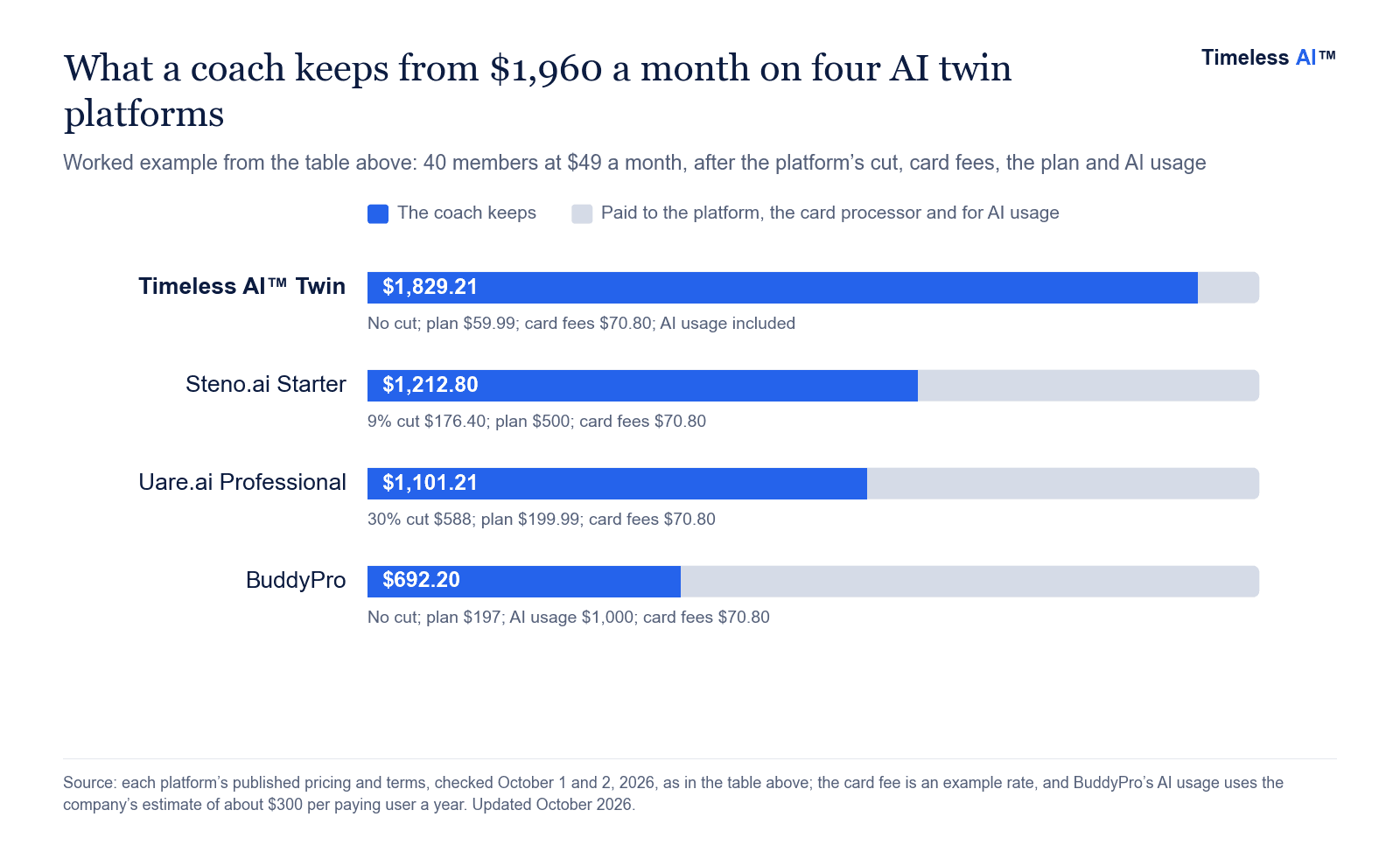
On Timeless AI™ Twin the coach keeps $728.00 more a month than on Uare.ai, which is $8,736.00 a year, and two paying members cover the Timeless Pro plan. Personify and Coachvox AI state no platform cut, which keeps their bills low, and neither one's published terms say anything about the owner's death. BuddyPro is built for subscriptions priced at about $1,997 a year, where its usage-based model fits best. A twin also earns where no membership exists at all, by answering website visitors around the clock and sending them to your booking link, and for eight worked examples of that, from a psychologist in Seattle to a plumber in Houston, read how an AI twin turns visitors into booked clients.
What happens to your digital twin when you die?
On every rival platform whose terms we read, the contract does not say what happens to your twin when you die, so the company decides by default. Silence in a contract has a predictable result. A dead user's account stops paying and goes quiet, the inactivity and termination clauses take over, and the clone is deleted, de-identified or left to whatever the company's next owner chooses. The table shows what each platform's own terms do when an account ends or goes quiet.
Platform | What the terms do when the account ends or goes quiet | Who decides at your death |
|---|---|---|
Uare.ai | Deletes or de-identifies your content and any AI you created on cancellation; may end inactive accounts | The company |
Synthesia | Deletes custom avatars with the account | The company |
Character.AI | May end accounts and discard content for any reason, including lack of use | The company |
Coachvox AI | May suspend or end accounts after six months or more of inactivity | The company |
HeyGen | May delete free accounts unused for six months, after notice | The company |
BuddyPro | Makes the twin inaccessible and deletes content from active systems on termination | The company |
Delphi | Deletes creator content on termination unless the creator elects six months | The company |
Timeless AI™ Twin | No inactivity clause; Executor Lock™ hands control to your executor, seals your Persona and keeps each door online only if you chose that | You, through the executor you named |
Companies change hands too, and a contract is what decides who holds your twin after a sale. Soul Machines, a New Zealand avatar company, went into receivership in February 2026 and was bought by AppDirect, and its standard terms let it assign customer contracts to a buyer, keep the avatars built in its studio and delete customer data 30 days after a contract ends (NZ Gazette; BERI, September 28, 2026). Eternos, the company that helped the Berlin entrepreneur Michael Bommer build an interactive AI of himself while he was terminally ill in 2024, renamed itself Uare.ai and moved into professional AI in November 2025 (Fortune, via AP; TechCrunch). HereAfter AI, the best-known voice legacy app, went offline in August 2026, which is why continuity has to be designed in.
Timeless AI™ Twin writes the answer into the contract, through section 8 of our Terms and the Executor Lock™ Agreement that you and your executor both accept. The six steps are the same for every Idy Persona and twin. Every step is decided by you while you are alive and carried out by the people you named.
Name your people. You name one or more executors and your Trusted Contacts, and each one accepts the Executor Lock™ Agreement while you are alive.
Report. After your death, an executor or a Trusted Contact you named uploads evidence, such as a death certificate or a funeral notice.
Check. Automated analysis reads the evidence, and then a person reviews the evidence before anything changes.
Cooling-off. Seven days pass in which every executor is told about the report and can dispute the report, and you can cancel a false report with proof of life.
Lock. Your Persona becomes a sealed snapshot of every memory as the memory stood that day, with nothing pruned, nothing re-weighted and a tamper-evident seal on the record.
Release. Each door follows its after-lock switch, and your family's access follows your release rules.
Our Terms call the lock permanent and irreversible (section 8.3), and nothing in the product can change your personality, tone or values after the lock. Your executor can invite the people you named, hand the role on and ask for deletion, and cannot unlock your Persona or edit a memory. On September 30, 2026, an Arizona appeals court vacated a sentence because a judge relied on an AI video of a dead man speaking words his family wrote, finding that the AI "erases the interpretive distance" between what a family believes and the person's own voice (Fox 10 Phoenix). A sealed twin speaks only from what you said and chose while alive, which is exactly the line that court drew. For the ownership question in depth, read who owns your AI likeness after you die.
Why did Idy build the hard part first?
Idy, the company behind Timeless AI™, spent its first years on the parts of personal AI that every platform in the tables above left out. Those parts are who controls your likeness while you live, who decides about the likeness when you die, who may see what, and how consent is recorded so that software actually obeys the consent. The result is Executor Lock™, built on technology covered by 78 patents pending, including verified handovers to a named executor, a memory record that becomes permanent at the handover, proof that consent was given, compliance across countries, and keeping a Persona the same person when the underlying AI models change. Idy has also filed two international patent applications under the Patent Cooperation Treaty.
Because that foundation came first, one Idy twin can do three things no rival in this comparison is built to do. Your twin works as you while you live, keeps answering and booking clients while you are away, and passes to the people you named when you die. Tavus, HeyGen and Synthesia were built for marketing and support videos, Delphi and Uare.ai were built to answer an audience, Character.AI was built for entertainment, and Twin1 was built for employers, so none of them names an executor or plans for its owner's death. A Lehigh University audit of 93 AI "afterlife" services found that 82 publish thin or no information on who has authority over a recreation (arXiv, August 28, 2026), and the twin market has the same gap.
Longevity is part of the same work. A twin that changes personality every time the provider swaps an AI model is not a stable copy of you, and keeping a Persona the same person across model changes is one of the areas Idy's patents pending cover; read will your AI survive model changes. Ownership is the other half, and our Terms say you keep ownership of everything you put in (section 6.1); read do you own your AI clone.
What is the best Delphi AI alternative in 2026?
The best Delphi AI alternative depends on why you are leaving. If you want a cheaper creator clone, Personify ($39 a month) and Coachvox AI ($83 a month billed yearly) cost less, and if you want a premium coaching product, BuddyPro and Steno.ai are built for that. If you want a twin that answers as you on your own website, inside your own app and inside AI assistants, with no cut of your fees instead of a private statement of work and an executor named in the contract, Timeless AI™ Twin is built for exactly that at $59.99 a month. Delphi named its top tier "Immortal", yet its terms never mention death, while section 8 of the Timeless AI™ Twin contract sets out exactly what happens at yours.
Delphi | Timeless AI™ Twin | |
|---|---|---|
Entry price | Free plan; Builder $79 a month; custom top tier to charge visitors | $59.99 a month or $599 a year |
Cut of your income | Private statement of work | None; clients book and pay you directly |
License to your content | Perpetual and irrevocable for submissions | You keep ownership of everything you put in |
Doors | Delphi's own surfaces | Your website, an API and AI assistants over MCP |
Your death in the contract | Not mentioned | Section 8 and the Executor Lock™ Agreement |
Named executor | None | Up to five executors |
Delphi remains a strong product for a creator who wants reach above everything else, and the table shows where the two differ for a professional who wants ownership and succession. Many people searching for a Delphi alternative already have a clone there and want to know what moving involves. For the full guide, including how to rebuild your knowledge as a Persona, read the Delphi alternative guide.
What happened to Eternos AI, and is Uare.ai the same company?
Eternos and Uare.ai are the same company. Eternos built AI versions of people, including the Berlin entrepreneur Michael Bommer, who spent two months and about 25 hours of talking to build an interactive AI of himself in 2024 as the company's first client (Fortune, via AP, June 4, 2024). In November 2025 the company renamed itself Uare.ai, raised $10.3 million and moved into professional AI, after finding that most prospective users were not preparing for death (TechCrunch, November 11, 2025). Uare.ai's current terms keep 30% of gross when creators charge, delete or de-identify a user's AI on cancellation and never mention death.
People searching for Eternos usually want what Eternos first promised, an AI of a person that lasts. That promise needs governance that survives a change of business plan, which is why Idy wrote Executor Lock™ into its contract and its product.
What are the best HeyGen, Synthesia and Tavus alternatives for a video of yourself?
The best alternative depends on whether you need a presenter for corporate video or a video of you that belongs to you. For corporate training and marketing at volume, HeyGen, Synthesia and Tavus are the specialists, and they compete with each other on avatar realism and price. For a video message in your own face and your own voice that sits inside a Persona with an executor named, Persona Video turns your Persona into video messages in your face and your own voice, made from one 30-second recording of you, and your first video is free. That makes Persona Video the natural choice for a welcome for new clients, a course introduction or a message to your family, made by you and governed by you.
The public figures who use their own likeness well share one habit, which is that they decide the rules themselves. In May 2025, Klarna's Sebastian Siemiatkowski and Zoom's Eric Yuan both used AI avatars on investor calls in the same week (TechCrunch, May 22, 2025), and Harvard Business School's Foundry program charges $699 for eight weeks of pitch practice against AI avatars of seven professors (PYMNTS, August 27, 2026). For the full guide, read make an AI video of yourself in your own face and voice.
Are there free digital twin apps?
Yes, most platforms offer a free way to start, and the free tier tells you a lot about what the paid product is for. Delphi, Uare.ai, Personify, MyClone, Tavus, HeyGen and Synthesia all list a free plan, with limits on messages, minutes or features, and HeyGen's free-plan output cannot be monetized. On Timeless AI™, your Persona build is free, with 25 memories and no card, so you can hear your Persona in your own voice and judge the fidelity before you pay anything. When your Persona sounds like you, Timeless Pro at $59.99 a month switches your twin on across all three doors.
Platform | Free option | What the free option is for |
|---|---|---|
Timeless AI™ | Free Persona build, 25 memories, no card, never expires | Building and testing the Persona your twin speaks from |
Delphi | Free plan | Trying a creator clone |
Uare.ai | Free plan | Trying a personal AI |
MyClone | Free plan with 500 text messages and 5 minutes of voice chat | Trying a clone on a website |
Personify | Free plan | Trying a creator twin |
HeyGen | Free plan | Trying avatar video; output cannot be monetized |
Synthesia | Free plan | Trying training video |
Tavus | Free developer plan | Building a video replica prototype |
What should you ask any digital twin app before you upload your life?
Ask every platform nine questions, including us, and expect written answers in the terms. Most platforms answer the first six on their marketing pages, and very few answer the last three anywhere. Silence on questions seven to nine means the company decides.
Do you need a face, a document bot or a twin of you? If you need a face for a training video, compare video tools and stop here.
Does the twin speak as you, in the first person, or about you?
Who owns the twin and what you upload? Check whether the ownership clause covers the model or only your uploads.
What does the twin know, and can a visitor change that? On Timeless AI™, only you teach your twin, and family, health and money stay out unless you add them.
Can you read every conversation and pause one channel without stopping the rest?
What is the platform's cut, who pays card fees, and is the rate public?
What happens if you go quiet for six months?
What happens when you die, who decides, what is frozen and who gets paid?
What happens if the company is sold or closes? On Timeless AI™, our obligations, including the permanent lock, pass to any successor (Terms section 16.4).
What do the laws say about AI twins in 2026?
The law in 2026 asks every AI twin to identify as AI and every likeness to have consent, and a governed twin is built to do both. Since August 2, 2026, the EU AI Act's Article 50 has required that people be told when they are talking to an AI, with fines up to €15 million or 3% of worldwide turnover (Baker Botts, September 2026), and every Timeless AI™ Twin carries a badge and says plainly when asked that the visitor is talking with the owner's AI twin. New York has required advertisers to disclose synthetic performers since June 9, 2026, with penalties of $1,000 and then $5,000 per violation (Office of the Governor of New York). India has required prominent labels on synthetic media since February 20, 2026 (Freshfields), and South Korea's AI Basic Act has required notice of AI involvement since January 22, 2026 (IAPP).
Professionals face one more rule. Illinois barred AI from providing therapy in August 2025, with fines of up to $10,000 (Illinois IDFPR), so a professional's twin explains how the professional works and points clients to the next step, and Timeless AI™ Twin never assesses, diagnoses or treats. For the country-by-country picture, read how the law treats a person's likeness, and for each profession, read professional AI for doctors, lawyers, lecturers and coaches.
How do you set up Timeless AI™ Twin?
You can set up Timeless AI™ Twin in an afternoon, and the first two steps are free. The order below produces the strongest twin, because a twin is only as good as the Persona underneath. Starting with your memories and your voice gives your twin your words and your sound before a single visitor arrives.
Build your Persona free. Talk to your Persona about your work, your methods and the questions clients ask you, starting with 25 memories and no card.
Record your voice and your Persona Video. Your Persona then speaks in your own cloned voice, and one 30-second recording lets Persona Video make messages in your face and voice.
Switch on Timeless Pro. Pro costs $59.99 a month and includes everything in Eternal, with unlimited memories and up to five executors.
Choose what your twin draws on and add your booking link. Your work and your methods come in by default, while family, health and money stay out unless you add them, and every ready visitor is sent to the booking page you choose.
Open your doors. Paste one line of code into your website, give your app a secret key for the API, or let AI assistants reach your twin over MCP.
Name your executor and set each door's after-lock choice. Decide door by door whether your twin keeps answering after the lock.
Try your twin as a visitor. Ask the hard questions your clients ask before you open a door, and add memories wherever an answer needs more of you.
Steps one and two are free and need no card, so you can hear your Persona in your own voice before you spend anything. For the twin in full, read Timeless AI™ Twin, the twin for working professionals, and for the building steps in depth, read how to make an AI version of yourself. Every plan and price is on Timeless AI™ plans and prices.
So which digital twin app should you choose?
Choose by the job. For a face in a marketing or training video, buy the best video-avatar tool for your budget, and for a premium coaching subscription or a document bot, the specialists above do those jobs well. For a twin of you that answers as you on every channel your clients use, books clients for you and passes to the executor you name, Timeless AI™ Twin is the platform built for that job, and every rival contract in this comparison leaves that third part to the company. Your Persona build is free, and your twin goes online the day you switch on Timeless Pro.
Frequently asked questions
What is the best digital twin app for a person?+
The best digital twin app for a person captures you faithfully and lets you own and govern the result, judged on fidelity, ownership, governance, voice and longevity. Timeless AI™ Twin is built on all five, with Executor Lock™ deciding what happens when you die. For video avatars, HeyGen, Synthesia and Tavus are the specialists.
What is the best AI twin platform in 2026?+
For a twin of you that answers clients in the first person on your website, through an API and inside AI assistants, and passes to the executor you name, the best platform is Timeless AI™ Twin at $59.99 a month. For presenter video, choose HeyGen or Synthesia, and for an audience clone for a large creator, Delphi.
What is the best AI clone app?+
The best AI clone app is the one whose contract you would sign for the rest of your life. Of the 12 platforms whose terms we read in full, Timeless AI™ Twin is the only one whose terms say what happens to your clone when you die, with an executor you name and a Persona sealed exactly as you left your Persona. For the shorter guide, read how to choose the best AI clone app.
How is a personal digital twin different from an industrial one?+
An industrial digital twin models a machine, building or process and is judged on sensor accuracy. A personal digital twin models you, meaning your memories, knowledge, personality and voice, and is judged on whether the twin answers the way you would.
Which AI twin platforms take a cut of my income?+
Uare.ai keeps 30% of gross on its $199.99 Professional plan, Steno.ai charges a 9% platform fee on its $500 Starter plan, BuddyPro charges a license and usage fees while you collect payments yourself, and Delphi sets creator payments in a private contract. On Timeless AI™ Twin, Idy takes no cut, because your twin sends clients to your own booking and payment tools, and you pay only the $59.99 Timeless Pro plan.
What happens to my AI twin when I die?+
On the 11 platforms whose terms we read, the contract does not say, so the company decides. On Timeless AI™ Twin, Executor Lock™ hands control to your executor after a verified report and a seven-day cooling-off, seals your Persona, and keeps each door online only if you chose that.
Why does ownership matter for a digital twin app?+
Ownership matters because the twin holds your identity, your knowledge and your voice. Our Terms say you keep ownership of everything you put in (section 6.1), while some rival terms grant the platform a perpetual, irrevocable license to your submissions.
Can a digital twin use my voice?+
Yes. With consent-based voice cloning, your Persona speaks in your own voice, your Timeless AI™ Twin answers visitors in that same voice, and Persona Video makes video messages in your face and voice from one 30-second recording you make yourself.
Can I try a digital twin app for free?+
Yes. Timeless AI™ offers a free Persona build with 25 memories and no card, so you can judge fidelity and control before you switch on your twin with Timeless Pro. Delphi, Uare.ai, MyClone, Personify, HeyGen, Synthesia and Tavus also list free plans.
Is Timeless AI legit?+
Yes. Timeless AI™ is a brand of Idy, the company behind Timeless AI™, which built the governance of personal AI first (consent, privacy, verified death and inheritance) and has 78 patents pending on that work. Idy publishes its Terms of Service, including what happens at your death, on its website. Twins are for people 18 and over (section 2.1), and our Terms bar building a Persona of anyone else without their explicit written consent (section 5.1).
Is an AI twin of myself creepy?+
A clone somebody else made without asking is the creepy kind. A twin you built yourself, carrying a badge, answering only from what you chose to share and governed by an executor you named, is your own work, published under your own name.
What happens to my twin if the platform shuts down or is sold?+
Read the assignment clause before you sign anywhere. Soul Machines' terms let the company assign contracts to a buyer and keep studio-built avatars, while our Terms pass Idy's obligations, including the permanent lock, to any successor (section 16.4).
How we researched this page
We read the published terms and price pages of Delphi, Uare.ai, BuddyPro, Steno.ai, Personify, Coachvox AI, MyClone, CustomGPT.ai, Sensay, Character.AI, Tavus, HeyGen and Synthesia on October 1 and 2, 2026, the StoryFile, Twincafe and Twin1 reporting linked above, and court, research and legal sources from the United States, the United Kingdom, Germany, India, South Korea, New Zealand and the European Union. Idy publishes Timeless AI™ Twin. Every outside fact links to its source and date.
Written and reviewed by Chris Williams, CEO & Founder, Timeless AI™
Published 29 June 2026 · Last updated 3 October 2026
Chris Williams is the founder and CEO of IDY Pty Ltd, the company behind Timeless AI and its sibling brand Afterlife AI. He writes about personal AI, digital identity, and how people can build a living AI self they own and govern.