
Written by Chris Williams, CEO & Founder, Timeless AI™ · Published 29 June 2026 · Updated 17 October 2026

How to make an AI version of yourself
Capture your memories, knowledge, personality and voice in a living AI self that you own and govern. This guide walks through every route, the seven steps that work, what each step costs in 2026, and how to keep your AI version yours for life and after.
To make an AI version of yourself, capture your memories, knowledge, personality and voice in a personal AI that you own and govern. On Timeless AI™ from Idy®, you talk to your Persona, clone your voice, record a Persona Video, put your twin online and name your executor under Executor Lock™. The build starts free, with no card.
Making an AI version of yourself means training a personal AI on your own memories, knowledge, personality and voice, so that your AI version can think, answer and sound like you while staying under your control. In 2026 that no longer takes a studio, a developer or a celebrity budget. Representative Jennifer Wexton of Virginia had an AI model of her own voice speak for her on the floor of the US House in July 2024 (Wikipedia), and LinkedIn co-founder Reid Hoffman published a 14-minute conversation with an AI twin built from two decades of his books, speeches, interviews and podcasts (Popular Science, May 1, 2024). The same result is now open to anyone with a phone, an afternoon and something worth passing on.
The difference between a convincing AI version of yourself and a generic chatbot with your name on it comes down to two things. The first is the depth and honesty of what you put in, because fidelity comes from your real stories and the reasoning behind your decisions. The second is who controls the result, today and after you die, because an AI that speaks as you is the most personal thing you will ever put online. This guide covers both, step by step, with real prices, real precedents from the United States, Germany, Sweden, India, China and Japan, and the exact settings that keep your AI version yours.
Definitions
AI version of yourself: a personal AI built from your own memories, knowledge, personality and voice that answers and sounds like you while staying under your control.
AI twin: an AI version of a real person that speaks in the first person, in that person's words, and answers questions on the person's behalf.
Persona: the private AI version of you that you build on Timeless AI™ by talking about your life, your work, your values and your voice.
Persona Video: video messages in your face and your own voice, made from one short recording of you.
Executor Lock™: Idy's patent-pending system of named executors, Trusted Contacts, a verified death report and a sealed snapshot of your Persona that can never be changed.
What is an AI version of yourself, actually?
An AI version of yourself is a personal AI built from your real material, meaning the stories you tell, the way you make decisions, the things you know and the way you speak. A generic assistant told to "act like you" is something else, because the assistant guesses at you from a few lines of instruction. A good AI version of yourself reflects your reasoning as well as your facts, so the AI knows why you decided something and not only what you decided. The better and more specific the input, the closer the result comes to your real judgment and tone.
People use several names for the same idea, and search engines treat them as close cousins. The table below sorts out the terms you will meet while you research, so you can tell what a product actually makes before you upload anything. For a wider definition of the category, read what a digital twin is.
Term | What the term usually means | What the product needs from you | Example |
|---|---|---|---|
AI version of yourself | Any AI that answers or appears as you | Depends on the product | The general search term for this whole page |
AI clone | A chatbot or voice trained on your material, usually for an audience | Documents, posts, recordings | Creator clones such as Delphi and Uare.ai |
AI avatar | A video face that reads scripts | A short video or a photo | Video-avatar tools such as HeyGen, Synthesia and Tavus |
Digital twin | Originally an engineering term for a virtual copy of a machine, now also used for people | Varies | Employer twins of staff, such as Twin1 |
AI twin | An AI version of a real person that speaks in the first person and answers on the person's behalf | Your memories, knowledge and voice | Timeless AI™ Twin |
Persona | The private AI version of you on Timeless AI™, built in conversation | Your stories, your voice, a short video of you | Your own Persona, governed by Executor Lock™ |
The useful distinction is between a face and a mind. An avatar gives you a face that says whatever someone types, while a Persona gives you a mind built from your own memories that can also speak in your voice and appear on video in your face. The strongest AI version of you combines all three, and the rest of this guide shows how.
Once your Persona is built, here is how to talk to yourself with AI, with the research behind it and five conversations worth having.
What are the ways to make an AI version of yourself?
There are four practical ways to make an AI version of yourself in 2026, and each one was built for a different job. A do-it-yourself chatbot is cheap and quick but holds only what you paste into the chatbot. A video-avatar tool makes a convincing talking head for marketing, training and support videos. A creator chat clone answers an audience from your published work. A governed Persona and twin captures your life and expertise in conversation, speaks in your voice, appears on video, answers for you on your own channels and passes to the people you name when you die.
Route | Best for | What you give | Time to a first result | Typical price (checked Oct 1 to 2, 2026) | Who decides after you die |
|---|---|---|---|---|---|
Do-it-yourself custom chatbot | A private experiment | Pasted notes and documents | Under an hour | Free tiers to about $99 a month (CustomGPT.ai Standard) | Whoever holds the account |
Video-avatar tool | Marketing, training and support videos | A 15-second to 3-minute video (HeyGen, Synthesia, Tavus) | Minutes to one business day | Free tiers; HeyGen paid from about $29, Tavus Starter $59 a month | The contract is silent |
Creator chat clone | Answering an audience | Posts, documents, courses, recordings | A few hours | Delphi Builder $79 a month; Uare.ai Professional $199.99 a month | The contract is silent |
Governed Persona and twin (Timeless AI™) | Your life and expertise, in your voice and face, working for you and passing to your executor | Conversation, your voice, a 30-second recording | An afternoon for the free build | Free build; Timeless Pro $59.99 a month for the twin | The executor you named, under Executor Lock™ |
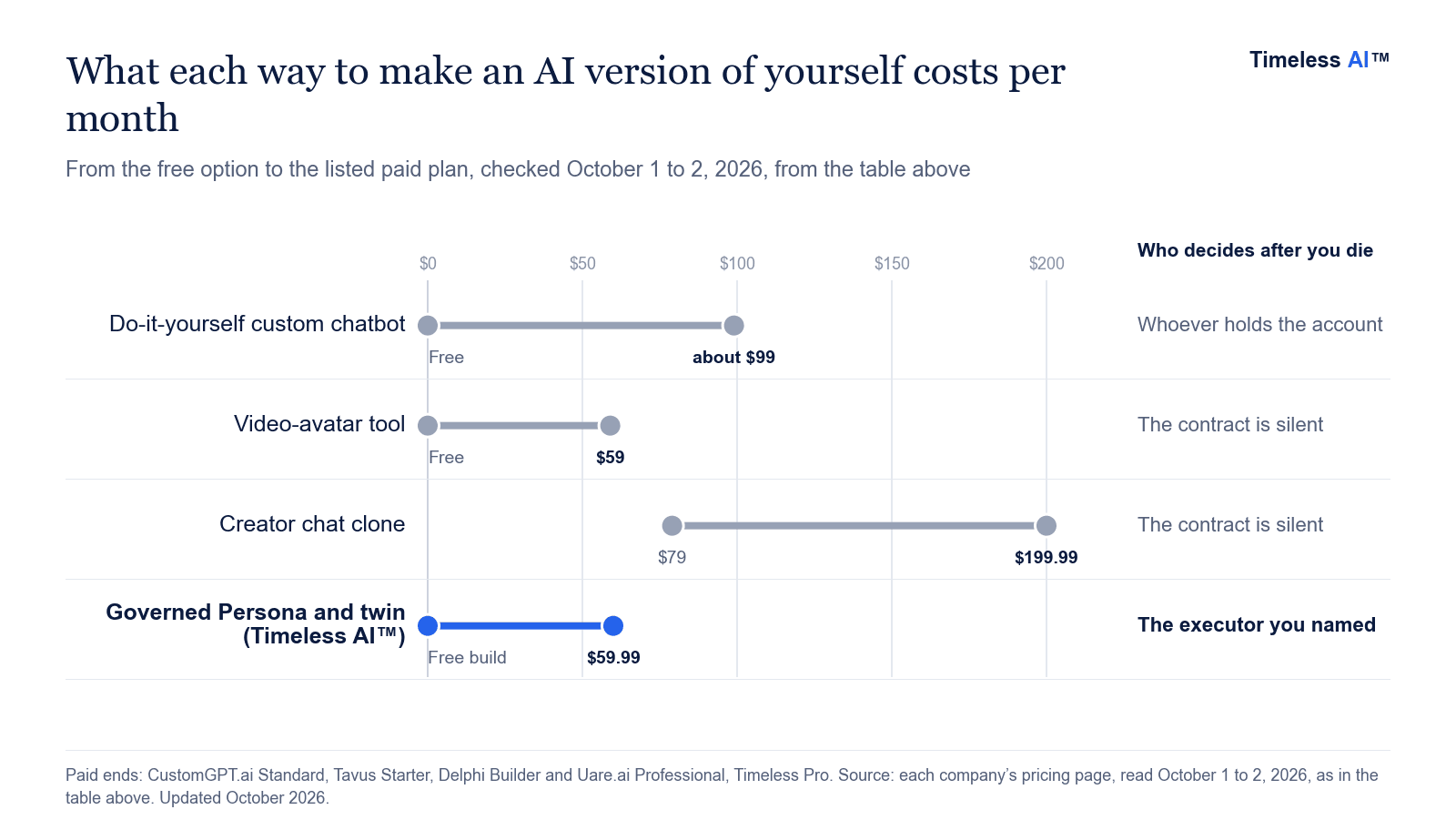
All prices are in US dollars. The rival prices come from each company's own pricing page and terms, which we read in full on October 1 and 2, 2026, and they change often, so check them again before you buy. HeyGen says "a single 15-second, front-facing video is enough for a full video twin" (HeyGen), Synthesia asks for two to three minutes of footage and a consent video for a personal avatar (Synthesia), and Tavus builds a replica "from just a two minute video" (Tavus pricing). Photo-based tools go further still and animate a single photo, as Creatify describes in its own guide (Creatify).
The last column is the one most guides skip, and it decides whether your AI version stays yours. When we read the full service terms of nine AI twin and avatar platforms in October 2026, about 85,000 words in total, none of them said what happens to your clone, your account or your earnings when you die, and five of the nine reserve the right to delete accounts for inactivity, which is exactly what an account looks like after its owner dies. Delphi even named its top tier "Immortal", and its terms never mention death. If your goal is a face for a marketing video, a video-avatar tool does that job well. If your goal is an AI version of you that knows your life, works for you and passes to the people you choose, you need the fourth route.
How do you make an AI version of yourself, step by step?
You make an AI version of yourself in seven steps, and the first four take a single afternoon. The steps below follow the order that produces the most faithful result, starting with your memories and ending with the rules that protect your AI version after you die. Each step names exactly what to do on Timeless AI™. You can work in any modern browser on a computer, on an iPhone or on an Android phone.
Step 1. Talk to your Persona and capture your memories
Start with the experiences that shaped you, including the defining moments, the decisions you are proud of, the mistakes that taught you something, and the people and places that matter. Your Persona asks one question at a time, and you answer by typing or by speaking, so the session feels like a conversation with a good interviewer rather than a form. Record the reasoning behind each event, because a memory with its reasoning attached is far more useful to your AI version than a bare fact. The free build holds your first 25 memories, never expires and needs no card.
Michael Bommer, a Berlin entrepreneur, showed how much a person can capture this way. Facing terminal cancer at 61, he spent about 25 hours over two months talking to build an interactive AI version of himself in 2024 (Fortune, via AP, June 4, 2024). Most people never have that warning, which is the best argument for starting with an ordinary Sunday afternoon instead.
Step 2. Add your knowledge and the way you decide
Layer in what you actually know, professionally and personally, including how you approach problems, what you believe and why, and the judgment you have built over years. This is the part that makes your AI version useful rather than merely sentimental, and it is where most of the long-term value sits. Tell your Persona about the questions you answer every week, the advice you always give and the mistakes you always warn people about. A lecturer might explain how she grades, a contractor how he prices a kitchen, and a founder how she decides whom to hire.
Kara Swisher, the technology journalist, sat for about two hours of interview to give an interactive twin 77 answers, which aired on CNN on May 16, 2026 (StoryFile). A Persona goes further because the conversation never ends, so every week you can add the answers people actually ask you for. Paid plans raise the memory limit to 500 on Legacy and to unlimited on Eternal and Timeless Pro.
Step 3. Clone your voice
Your AI version should sound like you, and a cloned voice is what turns text into your presence. You record your voice inside your Persona, and on the free build your first listen is free, so you hear your own voice reading your own words before you pay anything. On Legacy and above, your Persona speaks in your own cloned voice whenever you or the people you choose talk to your Persona. Record in a quiet room, speak the way you normally speak, and use your everyday pace rather than a presenter's voice.
Val Kilmer's story shows why you should record while your voice is at its best. After throat cancer affected his speech, he worked with a London voice company to rebuild his voice from archival recordings in 2021, and more than 40 vocal models were made to find the closest match (Wikipedia). A clean recording made today, by you and for you, saves that work and keeps the decision in your hands.
Step 4. Record your Persona Video
Persona Video turns one 30-second recording of you into video messages in your face and your own voice, and your first video is free. The recording runs in your browser in two halves, with 15 seconds of your face while you stay quiet and then 15 seconds of you reading a short passage aloud. Consent is recorded against that exact recording, and each video you make runs up to 30 seconds. You write the words yourself, up to 500 characters, or you let your Persona compose a short message in your own words.
Business leaders already use their own faces this way. In May 2025, Klarna's chief executive Sebastian Siemiatkowski used an AI avatar on an investor call, and days later Zoom's Eric Yuan opened his company's quarterly earnings call with his custom avatar (TechCrunch, May 22, 2025). For the full video guide, including recording tips and how Persona Video compares with HeyGen, Synthesia and Tavus, read how to make an AI video of yourself talking.
Thirty seconds in your browser, and your Persona can appear in your face and speak in your voice.
Step 5. Refine through conversation and see your life on the Mind Map
Talk to your AI version, ask questions and correct your Persona whenever an answer misses the mark. Each exchange sharpens your Persona so the answers reflect you more accurately over time, because fidelity improves the more you engage and never comes from a single upload. The Mind Map shows your memories as a constellation of your life, grouped into chapters, so you can see at a glance which parts of your life and work are covered and which are still thin. Tap any memory on the map to talk about the story behind the memory, and the next conversation always has a starting point.
A useful habit is to spend ten minutes a week on the gaps the map reveals. A career coach might notice that her Persona knows her methods but none of her client stories, and a grandfather might notice that his twenties are missing entirely. Filling those gaps is what makes an AI version of you sound like a whole person rather than a résumé.
Step 6. Put your twin online on three doors
When your Persona sounds like you, Timeless Pro puts your Timeless AI™ Twin online, and your twin answers visitors in the first person under your name and photo, in your words and your own cloned voice. Your twin works through three doors, and you open only the doors you want. The first door is your website, where you paste one line of code and your twin appears as a chat button. The second door is the API, where your app sends a secret key and gets your twin's answers back inside a course platform, a client portal or a staff tool. The third door is the AI assistants people already use, which can consult your twin directly over MCP, the open protocol AI assistants use to call other services.
Every visitor sees a small Timeless AI™ Twin badge, and when a visitor asks whether a person is typing, your twin says plainly that the visitor is talking with your AI twin. Your twin replies in the visitor's own language, explains how you work and points booking questions to your booking page. You read every conversation, kept for 365 days so you can see what people ask most, and you can pause or remove any door with one switch. Timeless Pro costs $59.99 a month or $599 a year, includes everything in the Eternal plan and 1,000 replies a month, and twins are for people 18 and over. For the full product, read Timeless AI™ Twin, the twin that answers your clients as you.
Your clients ask the same thirty questions every week. Let your twin answer them, in your words.
Step 7. Name your executor and set your rules
Decide who can access your AI version and on what terms, and lock those terms in. This is the step most people skip until it matters, and it is the step where Timeless AI™ differs most from every other route in the table above. You name an executor and your Trusted Contacts, each of whom accepts the Executor Lock™ Agreement while you are alive, and you set release rules that decide whether your photos, your memories and live conversation with your Persona reach your family after your death. For each twin door, one switch decides whether that door keeps answering after the lock.
The free build already includes Executor Lock™ setup with one executor and five Trusted Contacts. Eternal and Timeless Pro allow up to five executors and unlimited Trusted Contacts. The next sections explain exactly what happens to your AI version when you die and why we built this part before anything else.
Step | What you do | Time | Plan |
|---|---|---|---|
1. Capture your memories | Answer your Persona's questions by typing or speaking | About an afternoon for 25 memories | Free |
2. Add your knowledge | Explain your methods, beliefs and the questions you answer every week | Ongoing, 10 minutes a week | Free for 25 memories; 500 on Legacy; unlimited on Eternal and Pro |
3. Clone your voice | Record your voice inside your Persona | A few minutes | Free first listen; your Persona speaks in your voice on Legacy and above |
4. Record your Persona Video | One 30-second recording in your browser | About two minutes | First video free |
5. Refine on the Mind Map | Correct answers and fill gaps the map shows | Ongoing | Every plan |
6. Put your twin online | Open your website, API and AI-assistant doors | About 15 minutes | Timeless Pro, $59.99 a month or $599 a year |
7. Name your executor | Invite your executor and Trusted Contacts, set release rules and after-lock switches | About 10 minutes | Free (one executor, five Trusted Contacts) and up |
How long does it take, and what does it cost?
A useful AI version of yourself takes an afternoon to start and costs nothing until you want your Persona to speak in your voice or answer the public. The free build covers steps one, four and seven in full and steps two, three and five in part, so most people can judge the result before they spend a dollar. Depth comes with time, because a Persona built from 300 memories over a few months answers far more like you than one built from 25. The table lists every plan that matters for this guide.
Plan | Price (US dollars) | What you get |
|---|---|---|
Free build | $0, no card, never expires | 25 memories, unlimited chat with your Persona, voice recording with your first listen free, one free Persona Video, Executor Lock™ setup with one executor and five Trusted Contacts, up to 10 photos |
Legacy | $14.99 a month | Your Persona speaks in your own voice, 500 memories, unlimited photos, 150 seconds of Persona Video a month, 10 Trusted Contacts, one executor |
Eternal | $29.99 a month | Unlimited memories and storage, 390 seconds of Persona Video a month, unlimited Trusted Contacts, up to five executors |
Timeless Pro | $59.99 a month or $599 a year | Everything in Eternal, plus your Timeless AI™ Twin on your website, through the API and inside AI assistants, 1,000 replies a month in your own cloned voice |
Worked example: Dana, a career coach in Chicago. Dana is an invented example, and every price is real. She builds her free Persona on a Sunday in March, records her voice and makes her free Persona Video, and spends $0 in month one. She moves to Legacy for two months at $14.99 while she adds 200 memories about her coaching method, then switches to Timeless Pro for the remaining nine months of the year at $59.99. Her first year costs $0 plus $29.98 plus $539.91, which is $569.89 in total.
What Dana gets back is time. Before her twin, she answered about 20 routine emails a week from prospective clients, at about four minutes each, which is 80 minutes a week or roughly 69 hours a year. If her twin handles those questions on her website and inside AI assistants, and she values her hour at $150, the twin returns about $10,400 of her time in a year, against $569.89 of cost. The same Persona also keeps her stories and her voice for her own family, which no line in that arithmetic can price.
For comparison, a year of Delphi's Builder plan costs $948 and a year of Uare.ai's Professional plan costs $2,399.88, based on the monthly prices both companies published when we checked on October 1, 2026. Both are creator clones built to answer an audience, and neither contract says what happens to the clone when the owner dies. For eight professions with the numbers worked out, read how to monetize your expertise with AI, and for every plan detail, read every Timeless AI™ plan and price.
Can you make an AI version of yourself for free?
Yes. The Timeless AI™ free build gives any adult a Persona with 25 memories, unlimited chat, a voice recording with the first listen free, one free Persona Video and Executor Lock™ setup, with no card and no expiry date. That is enough to hear your own voice reading your own words, to see yourself on video, and to name the person who takes over when you die. You only pay when you want more memories, your Persona speaking in your voice every time, or your twin answering the public.
Other free routes exist, and each one does a narrower job. General chatbots can be told to imitate you from pasted notes, and video-avatar tools such as HeyGen let you make a video version of yourself on a free plan (HeyGen). Neither route keeps your memories in one governed place, and neither names an executor. If you start with a free avatar for a marketing clip, build your Persona alongside the avatar so your real stories and your voice live somewhere you control.
How do you make your AI version sound like you?
Your AI version sounds like you when two things match, your voice and your phrasing. Your voice comes from a clean recording that your Persona speaks with, and your phrasing comes from talking to your Persona the way you talk to people, with your own words, your own jokes and your own habits of speech. Typing in a formal style teaches a formal Persona, so speak your answers when you can, because spoken stories carry your natural rhythm. Correct any answer that uses a word you would never use, and your Persona learns from the correction.
The best precedent for a cloned voice is a person using their own voice by their own choice. Representative Wexton, who has progressive supranuclear palsy, became the first member of the House to have an AI model of her own voice speak for her on the floor, on July 25, 2024 (Wikipedia). The courts are now protecting the same idea from the other direction. In April 2024 the Beijing Internet Court held that a voice actor's rights extend to an AI voice that people can identify as hers and awarded her 250,000 yuan, about $34,500 (Beijing Internet Court), and in July 2024 the Bombay High Court barred anyone from cloning the singer Arijit Singh's voice without his consent (Columbia Global Freedom of Expression).
Five habits make the biggest difference to how closely your AI version matches you, and none of them needs any equipment beyond your phone.
Record your voice in a quiet room at your normal pace, the way you talk to a friend across a table.
Answer some questions out loud every week, because spoken answers carry your natural rhythm and phrasing.
Tell stories with names, places and the reason they mattered, because detail is what makes an answer sound like yours.
Correct your Persona the moment an answer sounds wrong, so your Persona learns your words instead of generic ones.
Cover your opinions as well as your facts, because people recognize you by what you think as much as by what you know.
What can your AI version of yourself do?
Your AI version can keep your stories for your family, answer the people who rely on your expertise, and represent you in video messages in your own face and voice. The examples below are invented and labeled as such, and each one uses features that are live today. They are drawn from the United States and from the other countries where people search for this guide most.
A statistics lecturer in Boston opens a website door so her students can ask her twin about the week's material at midnight, in the first person, with her grading rules and her favorite worked examples.
A grandfather in Dallas builds his Persona with his daughter beside him, records his voice and a Persona Video, and names his daughter as executor so his grandchildren hear his stories in his own voice for decades.
A startup founder in Bengaluru puts her twin inside her company's staff tool through the API, so new hires get the founder's own answers on culture, priorities and the reasons behind past decisions.
A management consultant in London connects his twin to AI assistants over MCP, so a prospective client's assistant can ask how he works, what he charges and what to prepare before a first call.
A language tutor in Seoul lets students talk to her twin in Korean, English or whatever language each student writes in, while she reads every conversation to see where students struggle.
A master plumber in Phoenix puts his twin on his website, so a homeowner with a leaking water heater at 10 p.m. gets his safety steps, his price range and his booking link, as our guide to AI for plumbers and electricians shows.
The world's companies are already cloning their experts, and the question is who holds the clone. BBC Future reported in August 2026 that Uber's chief executive rehearses presentations with a "Dara AI" and that Meta is building an AI twin of Mark Zuckerberg for employees (BBC Future, August 12, 2026). Those twins belong to the companies that built them. A Timeless AI™ Twin belongs to you, answers on the channels you choose and passes to the executor you named. For the full guide by profession, read professional AI for doctors, lawyers, lecturers and coaches.
What should you check before you start?
Before you put your real history into any tool, check five things, because a polished demo is easy to copy and real ownership and governance are not. The table lists the five questions and the answer Timeless AI™ gives to each one. Ask every product you consider the same questions, and walk away from any product that cannot answer them in writing.
Question | Why the question matters | How Timeless AI™ answers |
|---|---|---|
Ownership: whose AI is this? | Some platforms keep rights in what you build or can change terms later | Your Persona is built by you, from your own material, and our Terms bar anyone from building a Persona of another person without that person's explicit written consent (section 5.1) |
Governance: who controls access? | An AI that speaks as you needs rules that cannot be quietly changed | You decide who sees and talks to your Persona, which categories your twin draws on, and which doors are open; you read every conversation and pause any door |
Consent: is the AI built only from what you chose? | Clones built from scraped posts speak words you never chose | Every memory comes from you, and Persona Video records your consent against the exact recording |
Continuity: will your AI version survive change? | AI models change every year, and companies pivot | Keeping a Persona the same person when the underlying AI models change is one of the areas covered by Idy's patents pending; read will your AI survive model changes |
Death: what happens when you die? | Nine of nine rival contracts we read are silent | Executor Lock™ names your executor, verifies the death, seals your Persona and runs each door under your after-lock choice |
Your privacy rules are set category by category. When you set up your twin, your work, your values and who you are come ticked by default, while family, health and money are never ticked for you, so nothing personal reaches a visitor unless you add the category yourself. Visitors can ask your twin anything, but only you teach your twin, because visitor conversations never become memories. For the ownership question in depth, read do you own your AI clone.
What happens to your AI version of yourself when you die?
When you die, Executor Lock™ hands control of your AI version to the executor you named, seals your Persona exactly as you left your Persona, and runs every door under the rules you set. Nobody improvises these steps after the fact. An executor or Trusted Contact you named reports your death with evidence such as a death certificate, automated analysis and a human reviewer check the evidence, and a seven-day cooling-off follows in which every executor can dispute the report and you can cancel a false report with proof of life. Then your Persona becomes a sealed snapshot of every memory as the memory stood that day, with nothing pruned and nothing re-weighted.
Our Terms of Service call the lock permanent and irreversible (section 8.3), and nothing in the product can change your personality, your tone or your values after the lock. New short-term memories and big life events can still reach your Persona, so your daughter can tell your Persona she got married and your Persona remembers the news, while your personality, your tone and your values stay exactly as they were on the day of the lock. Each twin door follows the switch you set, labeled "Keep my Timeless AI™ Twin online after Executor Lock™", and the switch starts off so you decide door by door. Your executor can ask Idy to delete your Persona and your twin, which gives your family a clean ending if they ever want one.
The companies in this category have shown why the ending has to be written down by you. HereAfter AI, which grew out of a son's recordings of his dying father, went offline in August 2026, and families now have to email the company to ask for recordings, which is why our comparison of AI twin platforms reads what each contract says happens when you die. Eternos, the company that built Michael Bommer's AI of himself, renamed itself Uare.ai in November 2025 and moved into professional AI (TechCrunch, November 11, 2025). A Lehigh University audit published in August 2026 found that 82 of 93 AI "afterlife" services publish thin or no information on who has authority over a recreation (arXiv, August 28, 2026). For the executor's role, read how Executor Lock™ works, and for the ownership law, read who owns your AI likeness after you die.

How does Timeless AI™ approach an AI version of you?
Idy, the company behind Timeless AI™, built the hard part of an AI version of you before building the AI. That hard part is who controls your likeness while you live, who decides what happens to your likeness when you die, who may see what, and how consent is recorded so that software actually obeys the consent. Our answer is Executor Lock™, the system of named executors, Trusted Contacts, a verified death report and a sealed snapshot described above. The work behind that system is covered by Idy's 78 patents pending, which cover building a Persona over a lifetime, verifying a death before control changes hands, handing authority to a named executor and locking the Persona at that moment, consent with proof that consent was given, and keeping a Persona the same person when the underlying AI models change.
Because that foundation came first, one Persona can do several jobs that rival products keep separate. Your Persona keeps your life story for your family, your twin answers your clients on your website, in your apps and inside AI assistants, your Persona Video puts your face and voice on your messages, and every one of those pieces passes to the people you named when you die. Video-avatar tools such as Tavus, HeyGen and Synthesia were built for marketing and support videos, creator clones such as Delphi and Uare.ai were built to answer an audience, and Character.AI was built for entertainment, so none of them names an executor or plans for its owner's death. For a full comparison, read the best digital twin apps compared.
Researchers reached the same rules from the outside. In May 2024, researchers at the University of Cambridge's Leverhulme Centre for the Future of Intelligence called for consent from the person whose data builds an AI of them, constant transparency that users are talking to an AI, ways to opt out and dignified ways to retire a recreation (University of Cambridge, May 9, 2024). An AI version of yourself built on Timeless AI™ meets each of those demands with a decision you make in advance, which is why we tell everyone to start with the person, then the twin, then the rules.
Is it legal to make an AI version of yourself?
Yes. Making an AI version of yourself, from your own material and with your own consent, is legal everywhere we know of, and the laws passed in 2024 to 2026 protect your voice and likeness from other people rather than from you. Tennessee's ELVIS Act, in force since July 1, 2024, protects a person's voice, image and likeness against unauthorized AI use (Vanderbilt Law). On September 30, 2026, the Tokyo District Court held that unauthorized use of a performer's voice can infringe publicity rights (IOL, September 30, 2026). Courts in China and India have reached the same conclusion, as the voice section above shows.
The rules change when you put your AI version in front of the public. Since August 2, 2026, the EU AI Act's Article 50 has required that people be told when they are talking to an AI unless that is obvious, with fines up to €15 million or 3% of worldwide turnover (Baker Botts, September 2026), which is why every Timeless AI™ Twin carries a badge and answers truthfully about being an AI twin. New York has required advertisers to disclose "synthetic performers" in ads since June 9, 2026 (Office of the Governor). Making an AI of somebody else is a different matter entirely, and for the country-by-country picture, read how the law treats a person's likeness.
The clearest legal line of 2026 came from a US courtroom. On September 30, 2026, the Arizona Court of Appeals vacated a sentence because the judge had relied on an AI video of a man who had been killed, speaking words his family wrote, and said the AI depiction "erases the interpretive distance between the family's belief of what the victim would have said and the victim's own voice and opinions" (Fox 10 Phoenix, September 30, 2026). An AI version you build yourself sits on the right side of that line, because every word comes from you while you are alive. For who has the authority to make an AI of a person, read AI identity governance, explained.
So how should you make an AI version of yourself?
Start with your memories, add your knowledge, clone your voice, record your Persona Video, refine your Persona on the Mind Map, put your twin online where people already look for you, and name your executor before you finish. That order produces an AI version of you that sounds like you, looks like you, works for you and stays yours after you die. The free build takes an afternoon, and the most common mistake is treating the job as a one-off task, because the version of you in the real world keeps growing and your AI version should grow with you. If you want to compare the routes again, read how to clone yourself with AI and how to create a digital twin of yourself, and for family and after-death questions, read legacy planning with Timeless AI™.
Frequently asked questions
How do you make an AI version of yourself?+
You build a personal AI from your own memories, knowledge, personality and voice, refine your AI version through conversation, and set the rules for who controls the result. On Timeless AI™ that means seven steps, which are capturing your memories, adding your knowledge, cloning your voice, recording your Persona Video, refining your Persona on the Mind Map, putting your twin online and naming your executor under Executor Lock™.
Can I make an AI of myself for free?+
Yes. The Timeless AI™ free build gives you a Persona with 25 memories, unlimited chat, a voice recording with your first listen free, one free Persona Video and Executor Lock™ setup, with no card and no expiry. You pay only when you want more memories, your Persona speaking in your voice every time, or your twin answering the public.
How long does it take to build a good one?+
You can start in minutes and finish the free build of 25 memories in an afternoon. Fidelity improves as you add memories and conversations, and ten minutes a week on the gaps the Mind Map shows makes a large difference within a few months.
Can my AI version sound like me?+
Yes. You clone your voice inside your Persona, and on Legacy and above your Persona speaks in your own voice. Persona Video adds your face, making video messages in your face and your own voice from one 30-second recording.
What is the best way to clone myself with AI?+
The best way depends on the job. For a face in a marketing video, a video-avatar tool such as HeyGen or Synthesia does the job well. For an AI version of you that knows your life, speaks in your voice, answers your clients on your own channels and passes to your executor, build a Persona and a Timeless AI™ Twin.
How do I make an AI chatbot of myself that sounds like me?+
Build your Persona by talking, not by pasting documents, because spoken stories teach your phrasing and rhythm. Clone your voice, correct any answer that sounds wrong, and when you are ready, Timeless Pro puts your twin online as a chat on your website, an API for your apps and a service AI assistants can consult over MCP.
Can I make an AI version of myself on Android or iPhone?+
Yes. Timeless AI™ runs in any modern browser, so you can build your Persona, record your voice and make your 30-second Persona Video recording on an Android phone, an iPhone or a computer.
Do I own the AI version of myself?+
With Timeless AI™, you control your Persona, what your twin draws on, who can see each part and which doors are open, and you decide in writing who takes over when you die. Our Terms also bar anyone from building a Persona of another person without that person's explicit written consent.
Is it safe to make an AI version of yourself?+
Yes, when you build your AI version on a platform that records your consent and lets you control access. Your Persona Video consent is recorded against the exact recording, your twin always carries a badge and tells visitors the truth about being an AI twin, you read every conversation, and twins are for people 18 and over.
Is making an AI of yourself creepy?+
An AI built by you, from your own words, for the people you chose, is no stranger than a recorded interview or a letter. Strangers making AI versions of people without consent is the real problem, and building your own is the best protection against it.
What happens to my AI version when I die?+
Executor Lock™ hands control to the executor you named, checks the evidence of death, allows a seven-day cooling-off, and then seals your Persona as a perfect snapshot that nothing in the product can change. Each twin door follows the after-lock switch you set, and your executor can ask Idy to delete your Persona and your twin.
Why does Idy have 78 patents pending?+
Idy solved the hard part first. Before building twins, Idy worked out who controls a person's likeness, how a death is verified, how authority passes to a named executor and how a Persona is sealed so nobody can rewrite the record, and the 78 patents pending cover that work.
How we researched this page
We read the pricing pages and service terms of the AI clone, twin and avatar companies named in the tables on October 1 and 2, 2026, the court rulings and statutes linked in the legal section, reporting from TechCrunch, BBC Future, Popular Science, Fortune and Fox 10 Phoenix, and the University of Cambridge and Lehigh University research on AI recreations of people. Every outside fact links to its source and date.
Written and reviewed by Chris Williams, CEO & Founder, Timeless AI™
Published 29 June 2026 · Last updated 17 October 2026
Chris Williams is the founder and CEO of IDY Pty Ltd, the company behind Timeless AI and its sibling brand Afterlife AI. He writes about personal AI, digital identity, and how people can build a living AI self they own and govern.