
Written by Chris Williams, CEO & Founder, Timeless AI™ · Published 2 October 2026 · Updated 3 October 2026

How to make an AI video of yourself talking, in your own face and voice
Record yourself once, then make talking videos of you saying new things, in your real face and your own cloned voice. This guide covers how the technology works, the step-by-step, what every option costs in 2026, and how to keep your likeness yours.
To make an AI video of yourself talking, record a short clip of your face and voice, then give the AI the words and let the AI animate your face and speak in your cloned voice. On Timeless AI™ from Idy®, Persona Video does this from one 30-second recording, your first video is free, and Executor Lock™ governs your likeness.
AI video of real people has become a serious business in a very short time. Synthesia, which makes video avatars for corporate training and marketing, is valued at $4 billion with more than $100 million in annual recurring revenue (TechCrunch, September 26, 2026). In May 2025 the chief executives of Klarna and Zoom both delivered investor remarks through AI avatars of themselves within days of each other (TechCrunch, May 22, 2025). The same technology that lets a chief executive appear on an earnings call is now in your phone's browser, and making a talking video of yourself takes minutes.
There is a second reason to make yours now. Within a day of Dolly Parton's death on August 25, 2026, a fake AI recording of her "final wish" was spreading online, and Snopes rated the clip Fake (Snopes, August 26, 2026). Faces and voices are copied whether their owners agree or not, and the best protection a person has is an authorized version, made by them, with their consent on record and their rules written down. This guide shows you how to make that version, how it compares with HeyGen, Synthesia, Tavus and photo apps, and what the 2026 laws in the United States, the EU, the UK, India, China, South Korea and Japan mean for you.
Definitions
AI video of yourself: a video in which an AI makes your face and voice say words you never recorded, built from a real recording of you.
AI avatar: a video likeness of a person, generated by AI, that speaks words supplied as a script.
Voice clone: an AI model of your voice that can read new words in your voice.
Persona Video: video messages in your face and your own voice, made on Timeless AI™ from one 30-second recording of you.
Executor Lock™: Idy's patent-pending system of named executors, Trusted Contacts, a verified death report and a sealed snapshot of your Persona that can never be changed.
Can you make an AI video of yourself?
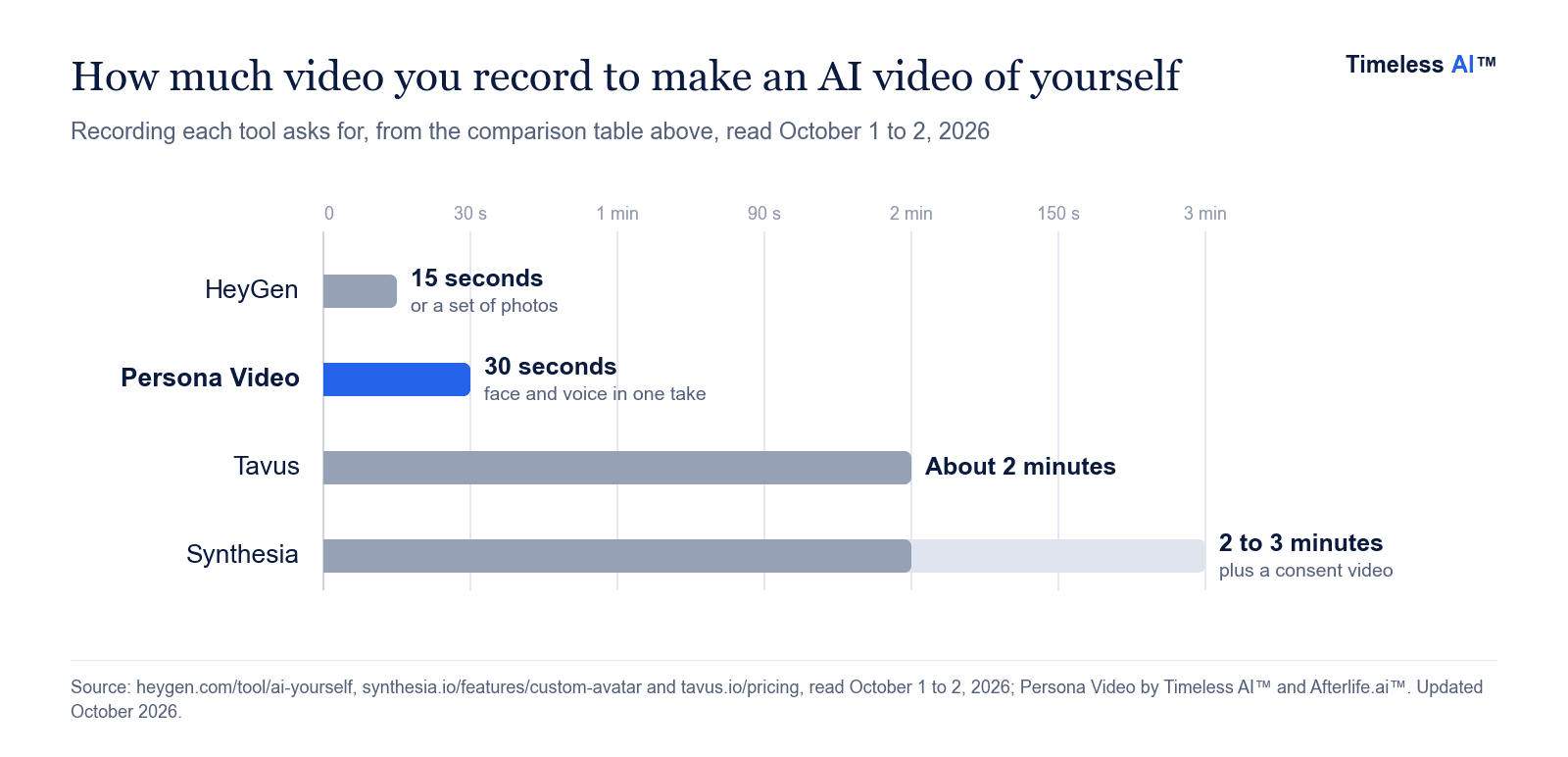
Yes. You can make an AI video of yourself talking with nothing more than a phone or laptop camera, and the quality in 2026 is good enough that most viewers cannot tell the difference at a glance. Every tool works the same basic way, by learning your face and your voice from a short recording and then generating new video of you saying new words. The tools differ in what they need from you, what they were built for, and who controls your likeness once the video exists. The table compares the main options as of October 2026.
Option | What you record | Built for | Your voice | Starting price (US dollars, checked Oct 1 to 2, 2026) |
|---|---|---|---|---|
Persona Video (Timeless AI™) | One 30-second recording in your browser: 15 seconds of your face, 15 seconds of your voice | Video messages in your face and voice, inside a Persona with an executor named | Cloned from the same recording | First video free; Legacy $14.99 a month |
HeyGen | "A single 15-second, front-facing video", or a set of photos | Marketing, course creation, training and executive communications | Cloned voice, 175+ languages | Free plan; paid from about $29 a month |
Synthesia | Two to three minutes of footage from a laptop or phone, plus a consent video | Corporate training, internal communications and sales | Cloned voice, translated into 29 languages | Basic $0; Starter $29; Creator $89 a month |
Tavus | A two-minute video | Conversational video agents for sales, interviews and learning | Cloned voice | Free developer plan; Starter $59 a month |
Photo-to-video apps | One photo | Quick talking clips from a still image | A stock or cloned voice | Free tiers; Creatify custom avatars from $19 a month |
The rival details come from each company's own pages, which we read on October 1 and 2, 2026: HeyGen, Synthesia, Tavus and Creatify. Each one does its own job well. If you need a presenter for a library of training videos, a video-avatar tool is the specialist. If you want video messages in your own face and voice that sit inside an AI version of you, governed by you and passed to the people you name, Persona Video was built for exactly that.
How does an AI video of yourself work?
An AI video of yourself works by pairing two models, one that animates your face and one that speaks in your voice, and then matching your lips to the words. The face part learns from footage of you, so the more natural and evenly lit your recording, the more natural every later video looks. The voice part learns from a sample of you speaking and can then read any new script in your voice. The system renders the new words as audio in your voice and moves your mouth to match, frame by frame.
Persona Video works from real footage of you, so your face, hair, lighting and background come from your own recording, and the system animates your mouth to match each new message. That approach keeps every video recognizably you, because nothing about your appearance is invented between one video and the next. Photo-to-video apps take the opposite approach and generate movement from a still image, which is quicker to start and usually less natural to watch. Studio avatars sit at the far end, with professional green-screen shoots that Synthesia says take between one and seven business days to process.
The voice is where most videos succeed or fail, because the people who know you notice a wrong voice at once. A video in your face with a stranger's voice feels wrong to anyone who knows you, while a video in your own voice feels like you even on a small screen. That is why Persona Video takes your face and your voice from the same 30-second recording, and why your Persona speaks with that same voice when the people you choose talk to your Persona.
How do you make an AI video of yourself with Persona Video, step by step?
You can make your first Persona Video in one short sitting, most of which is getting your Persona started, and the recording itself takes 30 seconds. The steps below work in any modern browser on an iPhone, an Android phone or a computer. Your first video is free, with no card.
Start your free Persona. Sign up on Timeless AI™ and your free build opens, with 25 memories, unlimited chat with your Persona and no expiry date.
Tell your Persona a few memories. Answer a handful of your Persona's questions, by typing or by speaking, so your Persona knows enough about you to compose a message in your own words if you want one.
Set up your shot. Sit facing a window or a lamp so your face is evenly lit, hold the camera at eye level, frame yourself from the chest up, and choose a quiet room.
Record 15 seconds of your face, quietly. After a three-beat count-in, look at the lens and stay relaxed and silent for 15 seconds, which gives Persona Video the footage of your face.
Record 15 seconds of your voice, reading aloud. A short passage appears under the lens, and you read the passage aloud in your normal voice for 15 seconds, which gives your Persona your voice.
Confirm your consent. You confirm consent for that exact recording, and Persona Video renders only from the recording you consented to.
Write your words or let your Persona compose them. Type what you want to say, up to 500 characters, or let your Persona compose a short message in your own words, and each video runs up to 30 seconds.
Watch your video, then make the next one. Your video arrives in your Persona, where you watch the video, delete the video if you change your mind, or make the next message from the same recording.
Recording well takes no equipment beyond your phone, and a few habits make the difference between a good video and a great one. The table lists the habits that matter most, based on what every face-and-voice system needs from its source footage.
Get this right | Why it matters | What to do |
|---|---|---|
Light | Shadows across your face become shadows in every video | Face a window or a lamp; avoid a bright window behind you |
Framing | A steady, front-facing head gives the cleanest mouth movement | Camera at eye level, chest up, phone propped rather than handheld |
Stillness in the quiet half | The quiet half becomes the base of every video | Relax your face, breathe normally and look at the lens |
Sound | Echo and background noise leak into a cloned voice | Record in a small, furnished room with doors and windows closed |
Your normal voice | People recognize your everyday voice, not your presenting voice | Read at your normal pace, as if talking to a friend across a table |
Your look | Every video wears what you wore on the day | Wear what you would wear to see the people who will watch |

What can you make with an AI video of yourself?
You can make any short message that is better coming from your face and your voice than from a text box. The examples below are invented and labeled as such, and each one uses Persona Video exactly as the feature works today. They come from the United States and from the other countries where people search for this guide most.
A father in Atlanta makes a 30-second birthday message for each of his three children every year, in his own face and voice, written in his own words.
A grandmother in Toronto makes a message about the recipe her family asks about every holiday, explaining the step everyone gets wrong, in the voice her grandchildren know.
A university lecturer in Boston makes a short introduction to each week of her course, in her own face and voice, so students meet the person behind the material.
A career coach in London makes a welcome message that explains how she works, what a first session covers and what to prepare.
A founder in Bengaluru makes a monthly 30-second update for her team, in her own face and voice, saying what matters this month and why.
A retired engineer in Munich makes a series of short messages explaining the decisions behind his best-known projects, for the colleagues and family who will ask about them later.
People who think about their own likeness carefully have used AI video and voice for exactly these jobs. Reid Hoffman released a 14-minute conversation with an AI twin built from two decades of his own books, speeches, interviews and podcasts (Popular Science, May 1, 2024), and Kara Swisher sat for about two hours of interview so an interactive twin of her could give 77 answers on CNN on May 16, 2026 (StoryFile). For the family angle in depth, read how to preserve your family's history.
How much does an AI video of yourself cost?
An AI video of yourself costs nothing to try and a few dollars a video after that. On Timeless AI™ your first Persona Video is free, Legacy at $14.99 a month includes 150 seconds of video a month, and Eternal at $29.99 a month includes 390 seconds, with each video up to 30 seconds long. Timeless Pro at $59.99 a month includes everything in Eternal plus your Timeless AI™ Twin. All prices on this page are in US dollars.
Plan | Price | Persona Video included | Also included |
|---|---|---|---|
Free build | $0, no card | One video, up to 30 seconds | 25 memories, chat, voice recording with first listen free, Executor Lock™ setup |
Legacy | $14.99 a month | 150 seconds a month (five 30-second videos) | Your Persona speaks in your own voice, 500 memories, unlimited photos, 10 Trusted Contacts |
Eternal | $29.99 a month | 390 seconds a month (thirteen 30-second videos) | Unlimited memories, unlimited Trusted Contacts, up to five executors |
Timeless Pro | $59.99 a month or $599 a year | 390 seconds a month | Everything in Eternal, plus your twin on your website, through the API and inside AI assistants, answering in your own cloned voice |
Worked example: Marcus, a father of three in Atlanta. Marcus is an invented example, and every price and allowance is real. He wants a 30-second birthday message for each of his three children and a 30-second monthly update for his family, which is 15 videos and 450 seconds a year. His free build covers the first video at $0. On Legacy at $14.99 a month he can make five 30-second videos a month, or 60 a year, for $179.88, which works out to $3.00 a video if he uses the full allowance and leaves him 45 spare videos for whatever comes up. Eternal at $29.99 a month gives him 156 thirty-second videos a year for $359.88, or about $2.31 a video, plus unlimited memories and up to five executors.
The video-avatar tools price for a different job. HeyGen's Creator plan costs $29 a month, Synthesia's Creator plan costs $89 a month, and Synthesia's custom studio avatar add-on costs $1,000 a year, based on the pricing pages we checked on October 1, 2026. Those plans are good value for a marketing team producing training libraries. For a person who wants messages in their own face and voice inside an AI version of themselves, Persona Video costs less and comes with an executor. For every plan detail, read every Timeless AI™ plan and price.
How is Persona Video different from HeyGen, Synthesia, Tavus and photo apps?
Persona Video is built around you as a person, while video-avatar tools are built around content for an audience. HeyGen, Synthesia and Tavus make presenters for marketing, training, sales and support at volume, and they do that job well. Persona Video makes messages in your face and your own voice inside your Persona, the AI version of you that knows your memories and speaks in your voice, and Persona Video is the only option in this guide that names an executor for your likeness. The table compares the points that matter once a video of you exists.
Persona Video | HeyGen | Synthesia | Tavus | |
|---|---|---|---|---|
Recording needed | 30 seconds, face and voice in one take | 15 seconds of video, or photos | 2 to 3 minutes, plus a consent video | About 2 minutes |
Built for | Your messages, inside your Persona | Marketing and training video | Corporate video at scale | Conversational video agents |
Consent | Recorded against the exact recording | Avatars built "with consent" | A recorded consent video | Consent script workflow |
Where your videos live | Inside your Persona, with no download button | Exported files | Exported files; custom avatars cannot be exported | Exported files and live agents |
An AI version of you behind the video | Yes, your Persona, with your memories and voice | No | No | No |
What happens when you die | Executor Lock™: named executors, verified report, sealed Persona | The terms are silent | The terms are silent | The terms are silent |
The last row comes from reading each company's full service terms on October 1, 2026, as part of a review of nine AI twin and avatar platforms and about 85,000 words of contracts. None of the nine said what happens to your clone, your account or your earnings when you die. HeyGen's terms allow free-plan accounts unused for six months to be deleted after notice, and Synthesia's terms say custom avatars cannot be exported and are deleted with the account (Synthesia customer terms, July 20, 2026). For the full platform comparison, read the best digital twin apps compared, and for avatar apps alone, read the best AI avatar apps.
Persona Videos stay inside your Persona and play without a download button, so the file stays with you instead of circulating online where anyone could edit or repost your face. That is a deliberate choice, and it is the same choice a careful person makes about any recording of their own voice and face. Your Persona Video exists to carry your words to the people you chose, under your rules.
Who has made AI videos and voices of themselves, and what happened?
The people who did this well made the decision themselves, while they were alive, and the stories that went badly were made by somebody else. The table sorts the best-known cases from five countries by that one question. The pattern is consistent across every culture and every legal system in the list.
Case | Country | What happened | Who decided |
|---|---|---|---|
Eric Yuan and Sebastian Siemiatkowski | United States and Sweden | The Zoom and Klarna chief executives delivered investor remarks through AI avatars of themselves in May 2025 (TechCrunch) | They did |
Jennifer Wexton | United States | An AI model of her own voice spoke for her on the House floor on July 25, 2024 (Wikipedia) | She did |
James Earl Jones | United States | Signed a deal in 2022 letting Lucasfilm generate Darth Vader's voice from archival recordings, two years before he died (Wikipedia) | He did |
ABBA Voyage | United Kingdom | Digital avatars of the band as they looked in 1979 have performed nightly in London since May 27, 2022, for more than four million visitors and over $2 million a week (Wikipedia) | The band did |
AI Hibari Misora | Japan | NHK staged an AI recreation of the singer, who died in 1989, singing a new song on September 29, 2019 (Japanese Wikipedia) | A broadcaster, 30 years after her death |
Meeting You | South Korea | MBC reunited a mother with a virtual-reality recreation of her daughter, who died at seven, in February 2020; the clip passed 19 million views (World Economic Forum) | The family and a broadcaster |
Christopher Pelkey | United States | His family's AI video of him, speaking words they wrote, played at the May 2025 sentencing; the Arizona Court of Appeals vacated the sentence on September 30, 2026 (Fox 10 Phoenix) | His family, with words he never said |
ABBA shows the commercial power of a likeness that its owners control. The band recorded once, and the avatars have worked every night since, in a show reported to have cost $175 million to build. The Pelkey case shows the opposite edge. The appeals court said the AI depiction "erases the interpretive distance between the family's belief of what the victim would have said and the victim's own voice and opinions", and a video you make yourself, in your own words, sits entirely on the right side of that line. For who has the authority to make an AI of a person, read AI identity governance, explained.
Is it safe to make an AI video of yourself?
Yes, when you make the video yourself, on a service that records your consent and lets you control where the video goes. Persona Video records your consent against the exact recording you made, renders only from that recording, keeps your videos inside your Persona without a download button, and lets you delete any video at any time. Your Persona is private to you and the people you choose, and twins are for people 18 and over. The safety question that matters most is what other people can do with your face and voice, and a governed, authorized version of you helps with that question too.
Voice and video fraud aimed at families is real. Fox News reported in June 2026 that the FBI's Internet Crime Complaint Center counted $352 million in AI-related scam losses among Americans aged 60 and over in a year, with voice clones built from social media and voicemail audio used to fake a grandchild in trouble (Fox News, June 11, 2026). Agree a family code word that no recording contains, and tell your family where your authorized videos live, so they always know which face and voice are really you. For keeping control of the recordings and data you share, read what to ask any AI provider about your data and how a personal AI should handle consent and control.
Is it legal to make an AI video of yourself?
Yes. Making an AI video of your own face and voice, with your own consent, is legal across the United States, the EU, the UK, India, China, South Korea and Japan, and the 2024 to 2026 laws protect you from other people using your likeness. Publishing AI video to the public now carries labeling duties in several places, and making AI video of someone else without consent is a crime in a growing list of countries. The table summarizes the rules that matter for a video of yourself.
Jurisdiction | The rule | In force | Source |
|---|---|---|---|
United States (federal) | The TAKE IT DOWN Act criminalizes publishing non-consensual intimate imagery, real or AI-generated, and platforms must remove it within 48 hours of a victim's request | Signed May 19, 2025 | |
Tennessee | The ELVIS Act protects a person's voice, image and likeness against unauthorized AI use | July 1, 2024 | |
New York | Advertisers must disclose "synthetic performers" in ads, with civil penalties of $1,000 and then $5,000 per violation | June 9, 2026 | |
European Union | People must be told when they talk to an AI, synthetic video must carry machine-readable marking, and deepfakes must be labeled; fines up to €15 million or 3% of worldwide turnover | August 2, 2026 (marking for systems already on the market by December 2, 2026) | |
Italy | Spreading a harmful AI-made video or voice of someone without consent carries one to five years in prison | October 10, 2025 | |
France | Publishing an AI montage of a person's image or words without consent, when its artificial nature is not obvious or stated, carries up to two years and €45,000 online | May 21, 2024 | |
Denmark | A bill would give every person rights over realistic AI imitations of their face, voice and body, for 50 years after death | Bill; the European Parliament's research service expected the change to take effect in July 2026 | |
India | Synthetic media must carry a prominent label and provenance metadata; flagged content must come down within three hours | February 20, 2026 | |
China | All AI-generated content must carry visible labels and embedded metadata | September 1, 2025 | |
South Korea | The AI Basic Act requires notice when AI is involved, and realistic deepfakes must carry a visible notice for their whole length | January 22, 2026 | |
Japan | The Tokyo District Court held that unauthorized use of a performer's voice can infringe publicity rights | September 30, 2026 |
Courts have also confirmed that your voice belongs to you. The Beijing Internet Court held in April 2024 that a voice actor's rights cover an AI voice built from her recordings and awarded her 250,000 yuan, about $34,500 (Beijing Internet Court), and the Bombay High Court barred anyone from cloning the singer Arijit Singh's voice, vocal style or likeness without his consent in July 2024 (Columbia Global Freedom of Expression). For the law country by country, read who owns your AI likeness after you die, and for voice and likeness as assets in an estate, read the intangible estate.
Can professionals use an AI video of themselves?
Yes, and professionals get the most from pairing Persona Video with a twin that answers in their words. A lecturer, coach, consultant or founder records Persona Video messages in their own face and voice, and Timeless Pro, at $59.99 a month or $599 a year, puts their Timeless AI™ Twin online on their website, through an API and inside AI assistants, answering clients in the first person, in their own words and cloned voice, under their name and photo. The twin carries a badge, tells visitors the truth about being an AI twin, replies in each visitor's language and points booking questions to the professional's booking page. You read every conversation and pause any door with one switch.
Universities and firms have already shown the demand. Harvard Business School charges founders $699 for eight weeks of pitch practice against AI avatars of seven of its professors, and Georgia Tech's AI teaching assistant classes recorded 66% A grades against 62% without the assistant (PYMNTS, August 27, 2026). Those avatars belong to the institutions that built them, while a Timeless AI™ Twin belongs to the professional and passes to the executor the professional named. For the full guide by profession, read professional AI for doctors, lawyers, lecturers and coaches, for eight professions with the numbers worked out, read how to monetize your expertise with AI, and for the twin itself, read Timeless AI™ Twin, the twin that answers your clients as you.
What happens to your AI videos and your likeness when you die?
When you die, Executor Lock™ hands control of your Persona to the executor you named, seals your Persona as a perfect snapshot, and applies the rules you set while you were alive. An executor or Trusted Contact you named reports your death with evidence, automated analysis and a human reviewer check the evidence, and a seven-day cooling-off follows in which every executor can dispute the report and you can cancel a false report with proof of life. Our Terms call the lock permanent and irreversible (section 8.3), and nothing in the product can change your personality, your tone or your values after the lock. Your executor can ask Idy to delete your Persona entirely, which gives your family a clean ending whenever they want one.
Robin Williams showed how much a person can decide in advance. His trust barred any use of his name, signature, photograph or likeness for 25 years after his death, with no adverts, no digital insertion into films and no holograms until at least August 11, 2039 (Harvard Journal of Sports and Entertainment Law, March 31, 2015). James Earl Jones made the opposite decision for one voice and one character, and both men left their families with an answer instead of a question. Executor Lock™ gives every adult the same power over their own face, voice and Persona, without a legal team. For the executor's role, read how Executor Lock™ works, and for the question of ownership, read why owning your AI identity matters.
The companies in this category have shown why the ending must be yours. HereAfter AI, which recorded parents' life stories for their families, went offline in August 2026, and families now have to email the company to ask for recordings, which is why our comparison of AI twin platforms reads what each contract says happens when you die. For how every Idy twin is governed after the owner dies, read how Timeless AI™ Twin passes to your executor.
Why did Idy build the hard part first?
Idy, the company behind Timeless AI™, settled who controls a person's face and voice before building any video of them. Most video-avatar companies started with rendering and left the questions of ownership, consent and death for later, and their contracts still leave those questions unanswered. We started with those questions, because a video of you is only as trustworthy as the rules behind the video, and our answers became Executor Lock™. The technology behind it is covered by Idy's 78 patents pending, which cover consent and permissions with proof that consent was given, verifying a death before control of a Persona changes hands, handing authority to a named executor, and sealing a Persona so the record cannot be altered after the handover.
That order of work is why Persona Video can do more than a video-avatar tool with the same footage. Your video comes from a recording you consented to, your voice and face live inside a Persona that knows your memories, and the people who take over when you die were named by you and accepted the Executor Lock™ Agreement while you were alive. Europe's governments have since written the same principle into a declaration signed under the Danish Council presidency by ministers from every EU member state except Hungary, stating that "Our citizens must be protected against digital replicas of their personal characteristics without consent" (European Parliamentary Research Service, January 2026). Persona Video was built on that rule from the start.
So how should you make an AI video of yourself?
Record yourself, once, on a service that records your consent, keeps your videos with you and names who takes over when you die. Face a window, prop up your phone, give Persona Video 30 seconds of your face and your voice, and make your first message free. Then build the Persona behind the video, so your face and voice belong to an AI version of you that knows your stories, and read how to make an AI version of yourself for the full seven steps. If you want to compare every route to an AI clone of yourself, read how to clone yourself with AI.
Frequently asked questions
Can I make an AI video of myself for free?+
Yes. Your first Persona Video on Timeless AI™ is free, with no card, and the free build also gives you a Persona with 25 memories and a voice recording with your first listen free. HeyGen and Synthesia also offer free plans for avatar videos aimed at marketing and training.
How do I make an AI video of myself talking?+
Record a short clip of your face and voice, give the AI the words, and let the AI animate your face and speak in your cloned voice. With Persona Video you record 15 seconds of your face and 15 seconds of your voice in your browser, confirm consent, then type your words or let your Persona compose them.
What is the best app to make an AI video of yourself with your own voice?+
For marketing and training video at volume, HeyGen and Synthesia are the specialists. For video messages in your own face and your own voice, inside an AI version of you that knows your memories and names an executor, Persona Video on Timeless AI™ is built for exactly that job.
How long does the recording take?+
The Persona Video recording takes 30 seconds after a short count-in, with 15 seconds of your face and 15 seconds of you reading a passage aloud. The whole process, from sign-up to a finished first video, fits comfortably into one short sitting.
How long can each video be?+
Each Persona Video runs up to 30 seconds. Legacy includes 150 seconds of video a month and Eternal and Timeless Pro include 390 seconds a month, so you can make five or thirteen full-length videos a month.
Can I make an AI video of myself from a photo?+
Photo-to-video apps can animate a single photo, and the result is quicker to start and less natural to watch. Persona Video works from 30 seconds of real footage of you, so your face, hair, lighting and background come from your own recording.
Is it safe to make an AI avatar of yourself?+
Yes, when you make the avatar yourself on a service that records your consent and controls where your videos go. Persona Video records consent against the exact recording, keeps your videos inside your Persona without a download button, lets you delete any video, and governs your likeness under Executor Lock™ when you die.
Can I leave video messages in my own face and voice for my kids?+
Yes. Persona Video makes messages in your own face and your own voice from one 30-second recording, and Executor Lock™ lets you name who takes over your Persona and set release rules for your photos, your memories and live conversation with your Persona.
Can someone else make an AI video of me?+
Not on Timeless AI™, where our Terms bar anyone from building a Persona of another person without that person's explicit written consent (section 5.1) and Persona Video renders only from a recording the person consented to. Elsewhere, laws in Tennessee, New York, Italy, France, India and China increasingly punish AI video of people made without consent.
Is an AI video of yourself creepy?+
A video you made yourself, in your own words, for people you chose, is a message from you. Fakes made by strangers are the real problem, and an authorized version of you is the best answer to them.
Do I need to label an AI video of myself?+
If you publish AI video to the public, labeling rules now apply in the EU, India, China and South Korea, and New York requires advertisers to disclose synthetic performers. Persona Videos live inside your Persona for the people you chose, and your Timeless AI™ Twin always carries a badge and tells visitors the truth about being an AI twin.
Why does Idy have 78 patents pending?+
Idy built the governance of a person's likeness before building the likeness itself. The 78 patents pending cover consent with proof that consent was given, verifying a death, handing authority to a named executor and sealing a Persona so nobody can rewrite the record.
How we researched this page
We read the product, pricing and terms pages of HeyGen, Synthesia, Tavus and Creatify on October 1 and 2, 2026, the statutes, court rulings and legal commentary linked in the law table, and reporting from TechCrunch, PYMNTS, Popular Science, Fox 10 Phoenix, Fox News, Snopes, the World Economic Forum and the European Parliamentary Research Service. Every outside fact links to its source and date.
Written and reviewed by Chris Williams, CEO & Founder, Timeless AI™
Published 2 October 2026 · Last updated 3 October 2026
Chris Williams is the founder and CEO of IDY Pty Ltd, the company behind Timeless AI and its sibling brand Afterlife AI. He writes about personal AI, digital identity, and how people can build a living AI self they own and govern.