
Written by Chris Williams, CEO & Founder, Timeless AI™ · Published 29 June 2026 · Updated 3 October 2026

Looking for a Sensay alternative? What happened to Sensay replicas, and where to build a twin you own
Sensay began as a platform for personal AI replicas and now sells one product, AI interviews that capture what departing employees know. This guide gives you the dated record, the steps to take if you built a replica there, and the best place to build a twin of yourself that you own.
Sensay, which launched personal AI "replicas" in September 2024, now sells only employee offboarding. Since November 10, 2025, its AI interviewer has captured departing staff's knowledge for $500 per knowledge base a year. If you built a replica there, export your material now, because Sensay may archive or delete replicas left unused for 12 months.
Sensay status | What we found | Source |
|---|---|---|
What Sensay sells now | AI Offboarding: "Capture, transfer and retain your team's critical know-how", used by "over 200 companies" | sensay.io, checked October 2, 2026 |
Price | $500 per knowledge base per year, with custom plans for larger programs and M&A integration | Sensay pricing, checked October 2, 2026 |
When it changed | Sensay AI Offboarding announced on November 10, 2025 as "the next evolution of Sensay" | |
Personal replicas | Launched on Product Hunt on September 29, 2024; a public chatbot directory is still online at chat.sensay.io | Product Hunt; chat.sensay.io, checked October 2, 2026 |
Unused replicas | "Inactive replicas that haven't been accessed for 12 months may be archived or deleted after notifying the user" | Sensay Privacy Policy, checked October 2, 2026 |
Inactive accounts | Sensay "reserves the right to terminate accounts that are inactive for an extended period of time" | |
Replicas made without permission | A take-down route by email to contact@sensay.io | Sensay take-down page, updated November 18, 2024 |
Last checked | October 2, 2026 | Every source on this page |
Sensay set out in 2024 to let anyone build a humanlike AI replica of themselves, and for a while it pitched replicas for everything from memory care to preserving what executives know. In November 2025 the company chose the second use and made it the whole business, which is a sensible move for a startup that found its paying customers in human resources departments. The people who built personal replicas on Sensay, and the professionals who wanted a twin of their own, now need a different home. Timeless AI™, from Idy®, gives a professional a twin built from their own Persona, owned by them, answering clients in their own voice on their website, through an API and inside AI assistants, with the ending written in under Executor Lock™.
Definitions
Sensay: an AI company founded by Dan Thomson that launched personal AI replicas in 2024 and has sold AI-led employee offboarding since November 2025.
AI offboarding: structured AI interviews with a departing employee, turned into a handover brief, a searchable transcript and a chatbot colleagues can ask.
Timeless AI™ Twin: a professional's AI twin, built from the professional's own Persona, that answers in the first person on a website, through an API and inside AI assistants, and passes to the professional's executor.
Executor Lock™: Idy's patent-pending system of named executors, Trusted Contacts, a verified death report and a sealed snapshot of your Persona that can never be changed.
What happened to Sensay?
Sensay moved from personal AI replicas to employee offboarding, announcing Sensay AI Offboarding on November 10, 2025 and selling nothing else on its website today. In June 2024 Sensay announced "humanlike AI replicas" under the headline "Introducing Digital Immortality", and pitched them for preserving executive knowledge, education, companionship for people with dementia and digital versions of online personalities (Sensay press release, June 17, 2024). Sensay Replicas then reached number two on Product Hunt on September 29, 2024. In 2025 the company announced Sensay Island, a micronation off Palawan in the Philippines to be run by a council of AI replicas of historical figures, which CNN reported in May 2026 has no international legal recognition (CNN via RNZ, May 16, 2026).
The record below is dated from Sensay's own pages and public reporting, and we update it whenever the status changes.
Date | What happened | Source |
|---|---|---|
June 17, 2024 | Sensay announces humanlike AI replicas under the headline "Introducing Digital Immortality" | |
September 29, 2024 | Sensay Replicas is the number two product of the day on Product Hunt | |
June 2025 | Sensay announces Sensay Island, to be governed by an AI Council of 17 replicas of historical figures | |
November 10, 2025 | Sensay launches AI Offboarding, "the next evolution of Sensay", from Singapore | |
May 16, 2026 | CNN reports that Sensay Island has about 12,000 residency applications and no international legal recognition | |
October 2, 2026 | sensay.io sells only offboarding, at $500 per knowledge base a year |
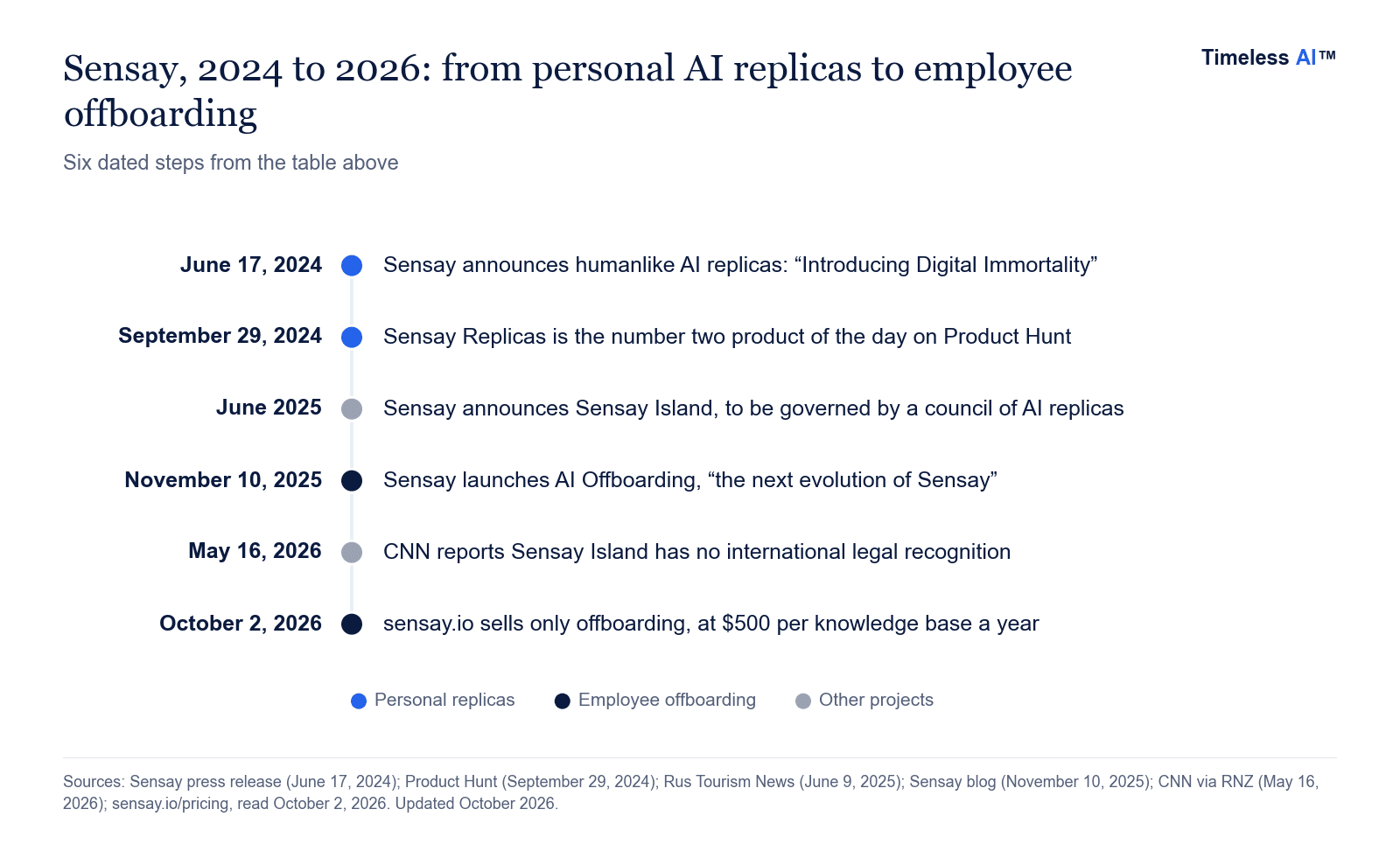
The plain reading of that record is that Sensay followed enterprise demand. Companies will pay to stop knowledge walking out of the door, and an HR budget is easier to sell to than individuals building replicas one at a time. The cost of that choice falls on people who built a personal replica and on professionals who wanted a twin of their own, because the product they signed up for is no longer the product Sensay sells.
Is Sensay still available for personal replicas?
No, Sensay no longer sells personal replicas on its website, which now offers only AI offboarding for companies. Its older public chatbot directory is still online at chat.sensay.io, where featured business agents sit alongside chatbots named after public figures and fictional characters (chat.sensay.io, checked October 2, 2026). Sensay's privacy policy still covers replicas, keeping replica data "for as long as the digital replica is active" and letting users delete a replica at any time, which triggers deletion of its data (Sensay Privacy Policy). The same policy says inactive replicas that have not been accessed for 12 months may be archived or deleted after Sensay notifies the user.
For someone who built a replica of themselves, the combination matters. The company's attention and its pricing have moved to offboarding, the replica directory still runs, and a replica you stop visiting can be archived or deleted after a year. If your replica holds stories, expertise or recordings you care about, export them now while you can still sign in.
What is Sensay AI Offboarding?
Sensay AI Offboarding is an AI interviewer, named Sophia, that interviews employees who are leaving a company and turns what they know into a handover brief, a searchable transcript and a chatbot colleagues can query in Slack or Microsoft Teams. Each departing employee typically completes two to three structured voice interviews over one to two weeks and can upload documents, PDFs and images alongside them (Newswire, November 10, 2025). The company sets up its account, invites leavers and tracks every interview from an admin dashboard. Sensay charges $500 per knowledge base per year and offers custom plans for companies managing many departures or an M&A integration (Sensay pricing, checked October 2, 2026).
The product's scope is clear and useful. It is built for HR teams to keep what leavers know inside the company, the knowledge base belongs to the employer, and the answers come from a few interviews near the end of someone's time in the job. Sensay's launch release cited IDC's estimate that Fortune 500 companies lose $31.5 billion a year to poor knowledge sharing and ineffective offboarding, which shows why buyers are interested. A professional who wants a twin of themselves, one that answers clients as them for years and stays under their own control, needs a different kind of product, and that is the gap the rest of this guide covers.
What should you do if you built a Sensay replica?
If you built a Sensay replica, sign in, export your data from your account settings, and decide deliberately whether to keep or delete the replica, rather than letting the 12-month inactivity rule decide for you. Sensay's privacy policy describes an "Export My Data" feature in account settings for a machine-readable copy, a "Delete My Data" option, deletion or anonymization within 30 days of a request, and backups kept for 30 days (Sensay Privacy Policy, checked October 2, 2026). Follow the steps below in order.
Sign in to your Sensay account. The replica directory still runs at chat.sensay.io, so sign in with the email you used to build your replica.
Use Export My Data in your account settings. Ask for the machine-readable export the privacy policy describes, and keep the file it produces.
Download your transcripts and training files. Save every document, note and recording you uploaded to train the replica, because the source material is the part you cannot rebuild.
Decide whether to keep or delete the replica. If you no longer want it online, use Delete My Data, which Sensay says it completes within 30 days, and keep a copy of the confirmation.
Mark the 12-month inactivity rule in your calendar. If you keep the replica, open it at least once a year, because replicas not accessed for 12 months may be archived or deleted after notice.
Save every file in three places. Keep two copies on drives you own and one in a cloud account you control, labeled by date and topic.
Rebuild where you own the result. Use the exported material as notes for a twin you own, built from your own Persona, with your executor named.
If you find a replica of yourself, or of someone you represent, that was made without permission, Sensay's take-down page asks you to email contact@sensay.io with the subject line "Take Down Request - Unauthorized Replica", with your details, a link to the replica and any proof of identity or authority (Sensay take-down page). For the ownership questions behind all of this, read whether you own your AI clone.
What makes a better Sensay alternative?
A better Sensay alternative is a twin that belongs to the person the twin represents, answers as that person wherever clients ask, and has a written plan for what happens when the person retires or dies. These are the seven reasons professionals choose Timeless AI™ Twin, each one a commitment written into the product or the contract.
Your twin is yours alone. A twin is made only from its owner's own Persona, and our Terms bar anyone from building a Persona of another person without that person's explicit written consent (section 5.1).
You own what you put in. Under section 6.1 of our Terms of Service, you keep ownership of all the content, memories, media and data you add, and section 6.2 says the license you give Idy does not extend to commercial use or to model training except under a separate agreement.
You see everything and control every door. You read every conversation your twin has and can pause any door with one switch.
Your twin answers where your clients already are. The three doors are your website, any app connected through the API, and the AI assistants people already use, reached over MCP.
Your twin speaks in your own voice. Visitors who speak to your twin hear your own cloned voice, and your twin replies in each visitor's language.
Your twin can meet people on video. Persona Video makes video messages in your own face and voice from one 30-second recording, with the first video free.
The ending is in writing. Executor Lock™ names who takes control when you die, and each door keeps answering after the lock only if you switched that door on.
Taken together, those commitments decide whether the expertise you put into a product stays valuable, because expertise has to stay yours, keep working as AI models change and have a named person in charge later. Our guide to whether your AI will survive model changes makes that case in detail.
Sensay vs the Timeless AI™ Twin: how do they compare?
Sensay captures a departing employee's knowledge for the employer, and the Timeless AI™ Twin puts a working professional's expertise online as the professional, so they serve different buyers. A company keeping a leaver's know-how buys Sensay. A consultant, founder, lawyer, adviser or engineer who wants clients and colleagues to keep getting answers in their own words, from a twin they own, chooses Timeless AI™. The table sets the two side by side.
Sensay AI Offboarding | Timeless AI™ Twin | |
|---|---|---|
Built for | HR teams keeping what departing employees know | Professionals who want a twin of themselves answering as them |
Who controls the result | The employer, with full admin control over each knowledge base | You own your content, memories and data (Terms section 6.1) |
How knowledge is captured | Two to three AI voice interviews over one to two weeks, plus uploaded files | Your own Persona, built in conversation over months and years, in your words |
What gets answered | Colleagues' questions, from the interview transcript | Clients', staff and visitors' questions in the first person, under your name and photo |
Where answers appear | Slack, Microsoft Teams or the web | Your website, any app through the API, and AI assistants over MCP |
Voice and video | Voice interviews, answers in chat | Your own cloned voice for visitors who speak, and Persona Video from one 30-second recording |
When the person retires or dies | The knowledge base stays with the employer | Executor Lock™ hands control to your named executor, and each door answers after the lock only if you switched that door on |
Price | $500 per knowledge base a year | Timeless Pro, $59.99 a month or $599 a year, with 1,000 replies a month |
The deciding row for a professional is the second one. A knowledge base owned by an employer is the right tool for an HR team, and a twin owned by the expert is the right tool for an expert. For the full product, read Timeless AI™ Twin, and for the wider category, read professional AI.

How do companies capture a retiring expert's knowledge?
Companies capture a retiring expert's knowledge best when the expert builds a twin while still working, so the twin learns from years of real questions rather than a few exit interviews. Interviews near the end of a job catch what the leaver remembers that week, while a twin built over months catches how the expert actually thinks through the problems colleagues and clients bring. An eGain and Deloitte report in June 2026 found that 92% of organizations fail to capture retirees' knowledge consistently, and it put the value at risk at $6.9 trillion to $9.6 trillion (Quiver Quantitative, June 22, 2026). That is why the best time to start a twin is while the expert is still doing the work.
Labeled example: Carmen Ruiz, a retiring engineering partner. Carmen Ruiz is an invented senior partner at a 40-person civil engineering firm in Denver who designed most of the water-treatment plants the firm still maintains. She plans to retire in two years, and junior engineers and clients ask her about 15 questions a week that nobody else can answer, on why a system was designed the way it was, which suppliers to trust and what a client was promised years ago. She builds her own Persona over a year of conversations, switches on her twin with Timeless Pro, and connects the staff door to the firm's internal chat through the API and the client door to her page on the firm's website. Her twin answers in the first person, under her name and photo, and she reads every conversation, so she corrects anything she would have put differently.
Carmen names her business partner and her daughter as executors, and both accept the Executor Lock™ Agreement while she is alive. She switches the staff door's after-lock setting on, so if she dies, her twin keeps answering engineers from the sealed snapshot of everything she taught while the firm hands her plants to the next generation, and she leaves the client door off after the lock. The twin stays hers throughout, because a twin is made only from its owner's own Persona. For the planning side, read how to capture founder knowledge before it is lost, an AI knowledge base for your business, key-person insurance explained, business continuity planning, the best succession planning tools and how to build a digital twin for your business.
What happens to an expert's twin when the expert leaves, retires or dies?
An expert's Timeless AI™ Twin stays the expert's own when they leave or retire, and when they die, Executor Lock™ hands control to the executors they named and keeps each door answering only if they switched that door on. Retirement changes nothing about ownership, because the twin was built from the expert's Persona in the expert's own account. Death follows the same six steps for every Timeless AI™ Twin.
Name your people. You name one or more executors and your Trusted Contacts, and each one accepts the Executor Lock™ Agreement while you are alive.
Report. After your death, an executor or a Trusted Contact uploads evidence, such as a death certificate.
Check. Automated analysis reads the evidence, and then a person reviews it before anything changes.
Cooling-off. Seven days pass in which every executor can dispute the report, and you can cancel a false report with proof of life.
Lock. Your Persona becomes a sealed snapshot of every memory, with nothing pruned and a tamper-evident seal, and nobody can edit a memory or change your personality.
Doors. Timeless AI™ Twins stay off after the lock unless you switched a door's after-lock setting on, and the doors you switched on keep answering from the sealed snapshot.
Why Idy built the hard part first. Idy, the company behind Timeless AI™, spent its first years on the questions that every expert-twin product eventually meets, which are who controls a professional's likeness while they work, who decides about it when they die, who may see what, and how consent is recorded so the software obeys it. The answer is Executor Lock™, built on technology covered by 78 patents pending, including verifying a death before control changes hands, handing authority to a named executor, sealing a memory record that becomes permanent at the handover, and keeping a Persona the same person when AI models change. Because that foundation came first, one twin can work as you while you practice, keep answering while you are away or retired, and pass to the people you named when you die. For the full mechanics, read how Executor Lock™ works.
What does a Timeless AI™ Twin cost?
A Timeless AI™ Twin costs $59.99 a month or $599 a year with Timeless Pro, in US dollars, and you build your Persona free before you switch the twin on. Timeless Pro includes everything in the Eternal plan, 1,000 twin replies a month and your own cloned voice for visitors who speak, and the yearly price saves $120.88 against twelve monthly payments. Twins are for people 18 and over.
Plan | Price | What you get |
|---|---|---|
Free | $0 | Create your Persona with 25 memories, no card |
Legacy | $14.99 a month | 500 memories, photos and audio memories |
Eternal | $29.99 a month | Unlimited memories and storage, Executor Lock™ |
Timeless Pro | $59.99 a month or $599 a year | Everything in Eternal, plus your Timeless AI™ Twin on your website, through the API and inside AI assistants, with 1,000 replies a month and your own cloned voice for visitors who speak |
At 1,000 replies a month, Timeless Pro works out to six cents a reply on the monthly plan. Your twin sends clients who are ready to talk to you to your own booking link or call-back form, so the decisions that need you still come to you. For every plan, read every Timeless AI™ plan, and for video, read an AI video of yourself.
What are the other Sensay alternatives?
The other Sensay alternatives each serve a narrower purpose, so the right choice depends on whether you want an audience clone, a branded avatar or a twin of yourself with an ending in writing. The table frames each by what it was built to do.
Alternative | What it is built for | Read more |
|---|---|---|
Delphi | Clones of people with large audiences, such as Arnold Schwarzenegger, that answer by voice or text (TechCrunch, November 11, 2025) | |
Soul Machines | Branded digital humans for companies; in receivership from February 2026 and sold to AppDirect on September 28, 2026 | |
Uare.ai (formerly Eternos) | An "Individual AI" for living creators and professionals | |
Video-avatar tools | Scripted marketing, training and support videos | |
Timeless AI™ Twin | A professional's own twin, answering as them on three doors, in their own voice, with Executor Lock™ |
If you want to start with your own Persona before choosing a plan, read how to make an AI version of yourself.
So what should you do this week?
If you built a replica on Sensay, export your data this week and save it in three places, because a replica left unused for a year can be archived or deleted. If you are a professional who wanted a twin of your own, build your Persona free, switch on your twin when your Persona sounds like you, and name your executor before your first client conversation. Sensay's move to offboarding shows how much companies value what their experts know, and a twin you own lets you keep that value in your own name.
Frequently asked questions
What happened to Sensay?+
Sensay launched personal AI replicas in 2024, then announced Sensay AI Offboarding on November 10, 2025 and now sells only that product, AI interviews that capture departing employees' knowledge for $500 per knowledge base a year.
Is Sensay still available?+
Sensay is still in business, selling AI offboarding to companies. Its website no longer sells personal replicas, although its public chatbot directory is still online at chat.sensay.io as of October 2, 2026.
What is Sensay AI Offboarding?+
Sensay AI Offboarding uses an AI interviewer named Sophia to interview departing employees over two to three sessions and turns the results into a handover brief, a searchable transcript and a chatbot colleagues can ask in Slack or Microsoft Teams.
How much does Sensay cost?+
Sensay charges $500 per knowledge base per year, with custom plans for companies managing many departures or an M&A integration, according to its pricing page on October 2, 2026.
What happens to my Sensay replica if I stop using it?+
Sensay's privacy policy says inactive replicas that have not been accessed for 12 months may be archived or deleted after Sensay notifies you, and its terms allow it to terminate accounts that are inactive for an extended period. Export your data from your account settings now.
What should I compare in a Sensay alternative?+
Compare who owns the twin and the data, whether the twin answers as you in your own voice, where the twin can answer, whether you can read every conversation and pause any door, and whether the contract says who takes control when you die.
Do I own my AI with Timeless AI™?+
Yes. Under section 6.1 of our Terms of Service you keep ownership of all the content, memories, media and data you put in, and section 6.2 rules out model training except under a separate agreement.
Can my twin use my own voice?+
Yes. Visitors who speak to your Timeless AI™ Twin hear your own cloned voice, and Persona Video makes video messages in your own face and voice from one 30-second recording.
Is there a free option?+
Yes. You can create your Persona free with 25 memories and no card, and switch on your Timeless AI™ Twin with Timeless Pro at $59.99 a month or $599 a year when you are ready.
Can a company build twins of several experts?+
Yes. Each expert builds a twin from their own Persona in their own account, so every twin stays the expert's own, and companies planning twins for several experts can talk to us through our partner enquiry page.
How we researched this page
We read Sensay's website, pricing page, privacy policy, terms of service, take-down page, launch blog post and offboarding press release on October 2, 2026, along with Sensay's June 2024 replica announcement, the Product Hunt leaderboard, the CNN and Rus Tourism News reporting on Sensay Island and the eGain and Deloitte findings. Every outside fact links to its source and date.
Written and reviewed by Chris Williams, CEO & Founder, Timeless AI™
Published 29 June 2026 · Last updated 3 October 2026
Chris Williams is the founder and CEO of IDY Pty Ltd, the company behind Timeless AI and its sibling brand Afterlife AI. He writes about personal AI, digital identity, and how people can build a living AI self they own and govern.