
Written by Chris Williams, CEO & Founder, Timeless AI™ · Published 2 October 2026 · Updated 3 October 2026

Soul Machines went into receivership and was sold to AppDirect: what happens to your digital people, and what to do now
Soul Machines built some of the most lifelike digital humans in the world, then went into receivership in February 2026 and was sold to AppDirect in September. This guide gives customers the dated record, the contract clauses that now decide what happens to their avatars and data, a checklist for this month, and the alternative built on ownership.
Soul Machines, the New Zealand maker of AI digital humans, went into receivership on February 5, 2026 and was bought by AppDirect on September 28, 2026. Its standard terms let contracts pass to a buyer without consent, keep custom avatars as Soul Machines property, and give customers 30 days after termination to request a data backup.
Soul Machines status | What the record shows | Source |
|---|---|---|
Receivers appointed | February 5, 2026: Leon Bowker and Luke Norman of KPMG, over all of the company's present and future assets | |
Appointed by | Bartok International Limited, security trustee for the secured parties under a convertible note deed poll, using a general security deed dated June 21, 2024 | |
Public notice | Gazette notice 2026-ar623, published February 10, 2026 | |
Buyer | AppDirect, San Francisco, announced September 28, 2026; terms not disclosed | |
Structure | A wholly owned AppDirect subsidiary; its digital people and more than 40 AI advisors go into AppDirect's Devs.ai platform | |
Who owns custom avatars | Soul Machines, under clause 3.1 of its standard terms | |
Your data after the contract ends | May be destroyed; 30 days to request the most recent backup, provided all outstanding amounts are paid (clause 7.4) | |
Last checked | October 2, 2026 | Every source on this page |
Soul Machines made digital people for some of the best-known brands in the world, and the companies that deployed them now have a new counterparty, a new platform plan and contract clauses that decide what happens to their avatars. Every customer should act this month, while renewal conversations with the new owner are open and before any termination starts the 30-day clock on data. This guide quotes the clauses exactly and gives a dated checklist that legal, procurement and customer-experience leads can work through this week.
Many of those customers bought a digital human to give their brand a trusted face, and the strongest version of that idea is the face and expertise of a real person on your team. A Timeless AI™ Twin, from Idy®, answers as that person on your website, through an API and inside AI assistants, in the person's own words and cloned voice. The owner keeps ownership of everything they put in, reads every conversation, and names an executor under Executor Lock™.
Definitions
Digital human (Soul Machines calls these Digital People): a lifelike animated AI character that talks with people face to face on a screen, usually built for a brand.
Receivership: a process in which a receiver appointed by secured lenders takes control of a company's assets, often to sell the business.
Timeless AI™ Twin: a professional's AI twin, built from the professional's own Persona, that answers in the first person on a website, through an API and inside AI assistants over MCP.
Executor Lock™: Idy's patent-pending system of named executors, Trusted Contacts, a verified death report and a sealed snapshot of your Persona that can never be changed.
What happened to Soul Machines?
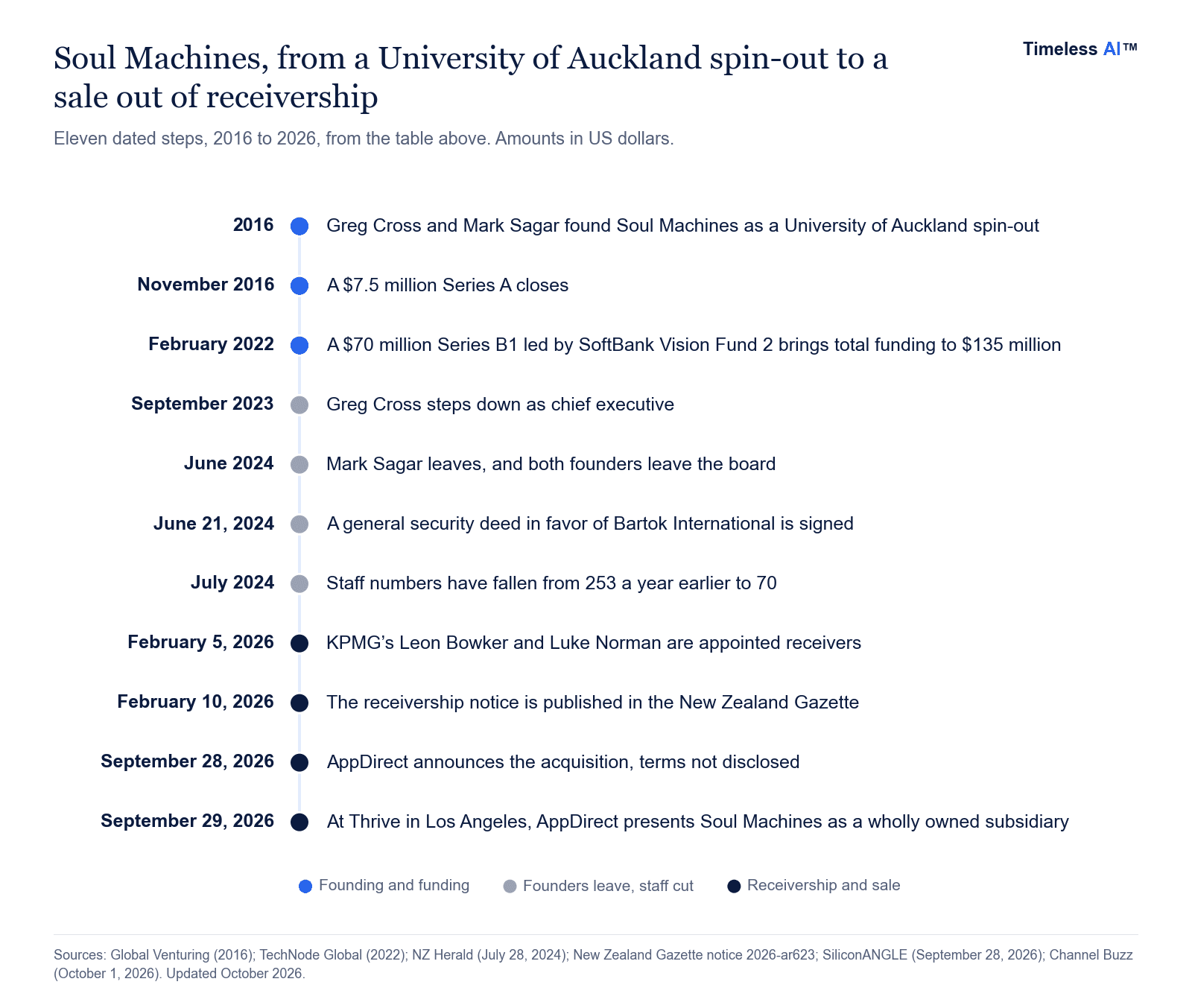
Soul Machines went from receivership to a sale in under eight months. On February 5, 2026, Leon Bowker and Luke Norman of KPMG were appointed joint and several receivers of Soul Machines Limited, over all of the company's present and future assets, and the appointment was published in the New Zealand Gazette on February 10 (New Zealand Gazette). On September 28, 2026, AppDirect announced that it had acquired Soul Machines, without disclosing the terms (SiliconANGLE, September 28, 2026). AppDirect presented the deal the next day at Thrive, its conference in Los Angeles, where it confirmed that Soul Machines will run as a wholly owned subsidiary (Channel Buzz, October 1, 2026).
Soul Machines is still operating, and no announcement has said that existing deployments will be switched off. What has changed is who stands behind the contract, where the technology is heading and how much leverage each customer has at renewal. The dated record below runs from the company's founding to the sale, and the rest of this guide helps customers manage all three changes. Every price on this page is in US dollars.
Date | What happened | Source |
|---|---|---|
2016 | Greg Cross and Mark Sagar found Soul Machines in Auckland, as a University of Auckland spin-out | |
November 2016 | A $7.5 million Series A closes | |
February 2022 | A $70 million Series B1 led by SoftBank Vision Fund 2 brings total funding to $135 million | |
September 2023 | Greg Cross steps down as chief executive | |
June 2024 | Mark Sagar leaves as chief science officer, and both founders leave the board | |
June 21, 2024 | A general security deed in favor of Bartok International is signed, the deed the receivers were later appointed under | |
July 2024 | Staff numbers have fallen from 253 a year earlier to 70, and Bartok International holds just under a third of the company | |
February 5, 2026 | KPMG's Leon Bowker and Luke Norman are appointed receivers | |
February 10, 2026 | The receivership notice is published | |
September 28, 2026 | AppDirect announces the acquisition | |
September 29, 2026 | AppDirect presents the deal at Thrive in Los Angeles: a wholly owned subsidiary, with digital people and more than 40 AI advisors going into Devs.ai |
What is Soul Machines?
Soul Machines is a New Zealand company that builds human-like digital people, animated AI characters that talk with customers and staff face to face on a screen. Greg Cross and Mark Sagar founded the company in 2016 (TechNode Global, February 18, 2022), and it began as a University of Auckland spin-out built on Baby X, an interactive animated infant that Sagar's research team created at the university (Global Venturing, November 24, 2016). Sagar had already won two Scientific and Engineering Academy Awards, one shared in 2010 for the Light Stage facial capture and rendering system used on films such as Spider-Man 2 and Avatar (USC Institute for Creative Technologies), and one in 2011 for his facial motion retargeting work (fxguide). Coverage of the sale described avatars that "see, listen, react and remember interactions", used for customer support and self-service, learning and development, training, employee help desks and digital commerce (SiliconANGLE, September 28, 2026).
The company raised serious money and won serious customers. In February 2022 SoftBank Vision Fund 2 led a $70 million Series B1, with Temasek, Salesforce Ventures and Horizons Ventures among the existing investors taking part, which took total funding to $135 million. TechNode named Carmelo Anthony, Nestle Toll House, P&G, Twitch, the World Health Organization and the Pan American Health Organization among the brands and celebrities Soul Machines worked with, and reported the company's plan to launch "hyper-realistic digital twins of real life celebrities". That a company of that standing reached receivership four years later shows how quickly the digital human market moved, and why every customer should read the contract behind its digital people now.
What is Soul Machines Studio?
Soul Machines Studio is the company's self-serve tool for developers, which its homepage describes as "the developer destination for building experiences from scratch or testing custom integrations", with a seven-day free trial (Soul Machines, checked October 2, 2026). The homepage also sells Digital Workforce, for deploying human-like AI agents into business roles, and Workforce Connect, an app for placing those digital workers inside the workflow tools a company already uses. On the day we checked, the homepage did not yet mention AppDirect. Digital people and custom avatars built on the platform fall inside the "Soul Machines Work" that the standard terms say Soul Machines owns, which is why the ownership section below matters to every Studio customer.
Why did Soul Machines go into receivership?
Soul Machines went into receivership because its secured lenders, acting through a security trustee, appointed receivers over all of the company's assets. The Gazette notice records that Bartok International Limited made the appointment as security trustee for the secured parties under a convertible note deed poll, using a general security deed in its favor dated June 21, 2024 (New Zealand Gazette). A receiver appointed this way takes control of the secured assets on behalf of the lenders, and a sale of the business is a common outcome. Neither the receivers nor the buyer has published a fuller explanation.
The public record from 2023 and 2024 shows the pressure building. The NZ Herald reported in July 2024 that Greg Cross had stepped down as chief executive in September 2023, that Mark Sagar had left in June 2024, that staff numbers had fallen from 253 to 70 in a year, and that Bartok International had tripled its stake to just under a third of the company (NZ Herald, July 28, 2024). The same report said the company's accounts for the year to March 31, 2023 carried a going-concern warning, and that early customers including Air New Zealand, ANZ and Mercedes-Benz had stopped using the technology. For customers today, what matters is the result, which is a new owner and contracts that can move with the business.
Who bought Soul Machines, and what is AppDirect?
AppDirect, a San Francisco company that runs a cloud marketplace for business technology with billing and provisioning, bought Soul Machines, and it has raised about $511 million from investors (Dealroom, September 28, 2026). "Soul Machines helps us take the next step in making AI more useful and more accessible for businesses," said Nicolas Desmarais, AppDirect's chairman and chief executive (SiliconANGLE). SiliconANGLE reported that the avatars will soon be available in apps built in Devs.ai, which it described as an enterprise vibe-coding platform powered by AppDirect that lets developers build apps and agents. Channel Buzz reported from Thrive that Soul Machines will operate as a wholly owned subsidiary and that its digital people and more than 40 "LLM-agnostic AI advisors" are going into Devs.ai (Channel Buzz).
Customers should read the plan as a change of direction. A product sold as a branded digital human is becoming one capability inside a larger AI platform, so roadmaps, pricing, support and data flows can all change at renewal. Customers who ask their questions now, in writing, negotiate from the strongest position they will have, and the checklist below gives them the questions.
What happens to Soul Machines customers' digital people and avatars?
Soul Machines customers' digital people stay governed by the standard terms they signed, and those terms give Soul Machines the ownership, the right to move the contract and the right to destroy customer data after the contract ends. Unless your company negotiated different terms, the clauses below decide what happens next. We read the Terms and Conditions and the Data Retention Policy on October 2, 2026 (Soul Machines terms; Data Retention Policy). Rajesh Beri's analysis for BERI on September 28 reached the same reading and advised customers to confirm the new counterparty in writing, request backups now and renegotiate before renewal (BERI). Clauses like these are common in enterprise software, and a sale is exactly the moment they start to matter.
What the standard terms say | The clause | What it means for you |
|---|---|---|
The contract can move to a buyer | 8.2: "either party may assign this Agreement in connection with a merger, reorganization, acquisition or other transfer of all or substantially all of such party's assets or voting securities" | Your contract can now sit with the new owner without your consent |
Soul Machines owns the avatars | 3.1: Soul Machines owns "all rights, title and interest, including all intellectual property rights" in the Soul Machines Work, including "Digital People, Custom Avatars and the HumanOS Platform", plus Usage Data | The custom avatar you paid to build belongs to Soul Machines |
On exit, you delete and certify | 7.4: the customer must "delete any copies of the Digital People and Custom Avatars from the Customer Applications and certify in writing" | Leaving means removing the avatar from your own apps |
Your data may be destroyed | 7.4: Soul Machines "may destroy or otherwise dispose of all Customer Data"; the customer "may within thirty (30) days of such termination or expiration, request the most recent back-up of Customer Data", provided all outstanding amounts are paid | You have 30 days after the end to ask for a backup, and unpaid invoices can block the request |
Conversation records are kept | Data Retention Policy: transcripts and audio or video "Raw data is not retained beyond a 12 month period" | Conversations can sit with the vendor for up to a year |
Face data of modeled people is kept | Data Retention Policy: facial-feature data for a digital human model is "retained for the life of the commercial and research use" of that model | A real person's face data can outlast your contract |
Do Soul Machines customers own their custom avatars?
No, under the standard terms Soul Machines customers do not own their custom avatars, because clause 3.1 places Digital People and Custom Avatars inside the Soul Machines Work that Soul Machines owns. A company that commissioned a branded character holds a license to use the avatar while the contract runs, and must delete the avatar from its own applications when the contract ends. For a brand asset that customers recognize, the face of your service belongs to a supplier that now belongs to someone else. For the ownership question across AI clones in general, read who owns an AI clone made for your business.
What should Soul Machines customers do now?
Soul Machines customers should secure their data this week, get the new arrangement in writing, and run a replacement pilot in parallel before renewal. The eight steps below follow the order a procurement team would use, with a deadline for each, and they draw on BERI's advice to customers (BERI). Step seven costs least and teaches most, because a Timeless AI™ Twin of one real expert takes an afternoon to build and goes on your website with one line of code. For the build itself, read how to build a digital twin for your business.
Step | What to do | By when |
|---|---|---|
1. Confirm your counterparty | Ask for written confirmation of which entity now holds your contract and who your account contact is | This week |
2. Request your data backup now | Ask in writing for the most recent backup of all Customer Data today, without waiting for termination, and clear any outstanding invoices so the backup right in clause 7.4 stays intact | This week |
3. Map every deployment | List each digital person you run, its owner inside your company, the channels it serves and the data it holds | This week |
4. Ask about the model and the data path | Ask which language model now powers your digital person and where conversation data goes inside Devs.ai | Within two weeks |
5. Ask about any real person's face data | Ask in writing what happens to facial-feature data of any real employee, executive or celebrity you modeled, and request deletion where you can | Within two weeks |
6. Renegotiate the terms that matter | Put ownership of your content, data return without a time limit and a change-of-control exit right on the table at renewal | Before renewal |
7. Run a replacement pilot | Put a twin of one real expert on one page or one internal tool and compare results | This month |
8. Brief legal and procurement | Share the clause table on this page and agree who owns the decision | This week |

What happens to a real person's digital twin when the company is sold?
A real person's digital twin goes wherever the vendor's contract and data policy send the likeness, unless the person decided otherwise in advance. Soul Machines worked with celebrities such as Carmelo Anthony and in 2022 announced plans for "hyper-realistic digital twins of real life celebrities". Under the standard terms, a digital person built on the platform sits inside the Soul Machines Work, and the Data Retention Policy keeps the facial-feature data of a modeled person "for the life of the commercial and research use" of the model. When the vendor changes hands, the likeness of a real athlete, executive or spokesperson travels with the vendor's assets, and the person behind the face may have no say in where the likeness goes next.
The cases where a real person decided in advance look very different. Darth Vader's voice is the best-known business example, because James Earl Jones agreed in 2022 that Lucasfilm could recreate his voice from archival recordings, and that written decision governed the voice after he died on September 9, 2024 (Wikipedia). A twin built and owned by the person, with an executor the person named, is the business version of that decision. For the ownership law, read who owns an AI clone made for your business and our guide to AI identity governance.
Which other AI avatar and twin companies changed hands or direction?
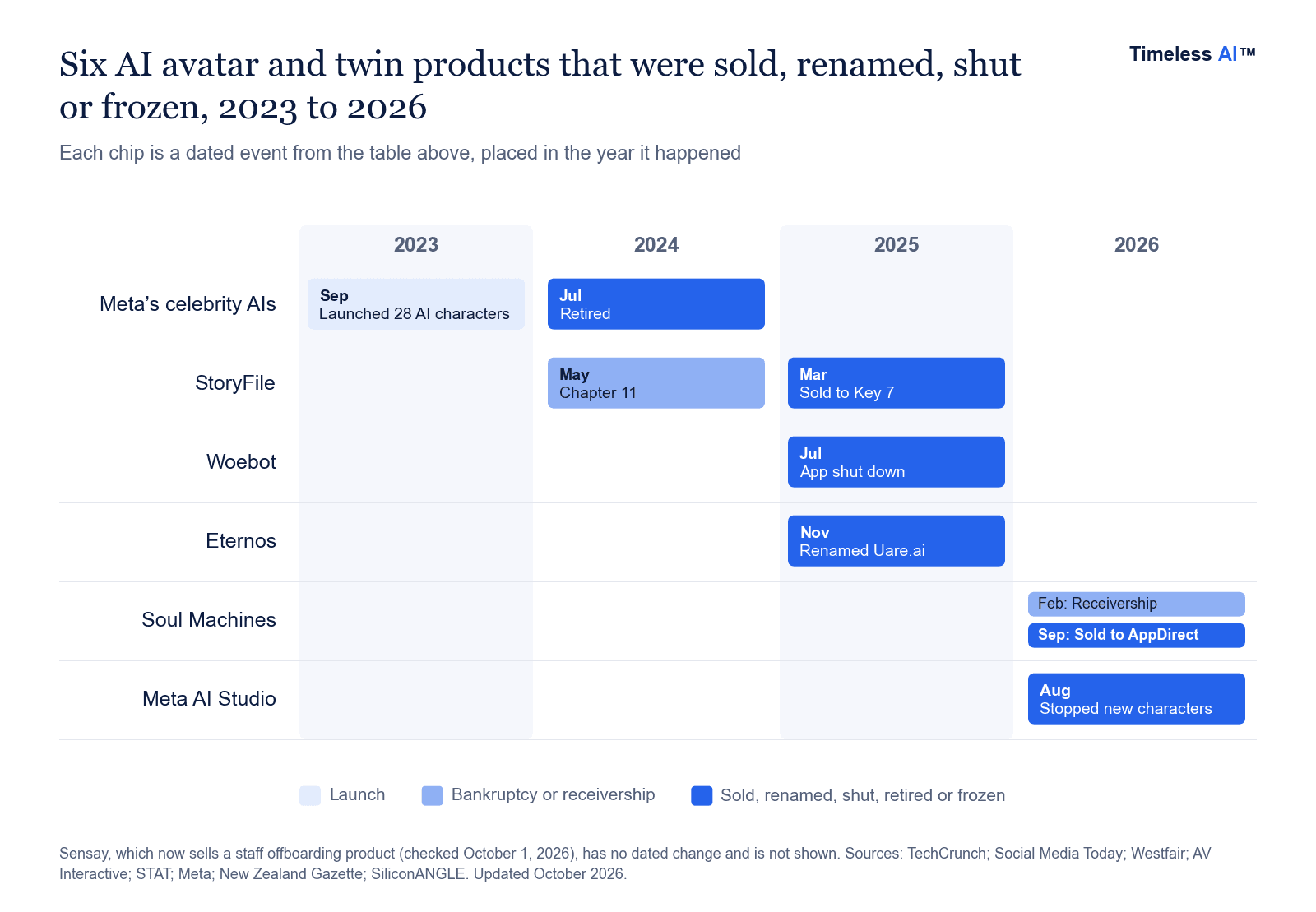
At least seven well-known AI avatar, twin and character products were sold, renamed, shut, frozen or turned to a new market between 2023 and 2026, and Soul Machines is the latest. The pattern runs across startups and the largest platforms alike, which is why a digital person is only as durable as the contract and the company behind it. The right contract and the right architecture survive a sale, and the buyer's checklist further down shows what to ask for.
Company or product | What happened | When | Source |
|---|---|---|---|
Meta's celebrity AIs | 28 AI characters launched, several played by celebrities, then retired | September 2023; July 2024 | |
StoryFile (US) | Chapter 11 with $1.5 million in assets against $10.5 million in liabilities, then sold to Key 7 Investment | May 2024; March 2025 | |
Woebot (US) | Shut its therapy chatbot app | July 2025 | |
Eternos (US) | Renamed itself Uare.ai, raised $10.3 million and moved into professional AI | November 2025 | |
Soul Machines (New Zealand) | Receivership, then sale to AppDirect | February and September 2026 | |
Meta AI Studio (US) | Stopped new AI characters and edits to existing ones | August 10, 2026 | |
Now sells a staff offboarding product at $500 per knowledge base a year | Checked October 1, 2026 |
What are the best Soul Machines alternatives?
The best Soul Machines alternative depends on whether you want an invented brand character or the expertise and presence of your real people. If you want an invented avatar for a kiosk, a training roleplay or a support flow, interactive avatar platforms such as UneeQ, Synthesia, HeyGen, D-ID and Tavus serve that scope, and Synthesia alone reached a $4 billion valuation in 2026 and sells interactive roleplay avatars for sales training (TechCrunch, September 26, 2026). If you want customers to meet a named expert they already trust, a Timeless AI™ Twin is built for exactly that. The table describes each option by its scope, with prices from each company's own pricing page on October 2, 2026. For deeper comparisons, read the best digital twin apps compared, the best AI avatar apps and the best AI avatar generators.
Option | Built for | Whose likeness | Public price |
|---|---|---|---|
UneeQ | Digital humans for sales, service and leadership training roleplay, plus brand ambassadors and website assistants | Studio-built characters | Demo or free trial; no public price |
Synthesia | AI video creation, with interactive avatars and roleplay sessions | Stock avatars or a custom presenter avatar | Starter $29 a month, Pro $89 a month (monthly billing) |
HeyGen | AI video avatars, with a separate LiveAvatar product for real-time conversation | Stock or custom avatars | Creator $29 a month, Pro $49 a month (monthly billing) |
D-ID | Visual AI agents, AI avatars and AI video | Stock or custom avatars | Studio and API plans |
Tavus | A conversational video interface for developers, with custom AI humans | Stock or custom replicas | Starter $59 a month for 100 minutes, Growth $397 a month |
Timeless AI™ Twin | A twin of a real professional, answering as that person on a website, through an API and inside AI assistants | The owner's own, built from the owner's own Persona | $59.99 a month or $599 a year |
Why choose a twin of your real people over an invented avatar?
A twin of a real person wins because customers trust a named expert more than a brand character, and because the person who owns the knowledge also owns and governs the twin. Your twin answers in the first person, under the person's name and photo, in the person's own words, and visitors who speak hear the person's own cloned voice. The owner reads every conversation, which turns the twin into a live record of what customers ask, and can pause any door at any time. Timeless Terms section 6.1 says "You retain ownership of all content, memories, media, and data you input into the Platform", and section 6.4 says Idy "does not use Your Content to train AI models unless expressly permitted under a separate agreement" (Timeless AI™ Terms of Service). Persona Video adds the face, making video messages in the expert's own face and voice from one 30-second recording, so a welcome on your homepage comes from the real person, and the first video is free. For the full method, read how to make an AI video of yourself.
An invented avatar | A Timeless AI™ Twin of your expert | |
|---|---|---|
Who the customer meets | A brand character | A named expert, in the first person |
Where the answers come from | A script and a knowledge base | What the expert taught the twin, in the expert's own words |
Voice | A stock or studio voice | The expert's own cloned voice when visitors speak |
Who owns what goes in | Set by the vendor's terms | The owner (Terms s6.1); no model training without a separate agreement (s6.4) |
Conversation record | Varies by vendor | Every conversation, readable by the owner |
If the expert leaves or dies | Not part of the product | Executor Lock™ with a named executor |
How does a Timeless AI™ Twin work for professionals and teams?
A Timeless AI™ Twin works by turning one professional's Persona into a twin that answers on three doors, which are your website, any app connected through the API, and the AI assistants people already use, reached over MCP. On the website, the twin appears through one line of code and carries a "Timeless AI™ Twin" badge, and when a visitor asks whether they are talking to a real person, the twin says warmly that the visitor is talking to the professional's Timeless AI™ Twin. Twins are for people 18 and over, and each twin is built only from the owner's own Persona.
Timeless Pro costs $59.99 a month or $599 a year per professional and includes 1,000 replies a month and everything in the Eternal plan. Organizations that want twins for several experts can talk to us through our partnership page. For more, read about the Timeless AI™ Twin, professional AI for founders, CEOs and specialists and, for sole traders, AI for plumbers and electricians.
What happens to an expert's twin when the expert leaves, retires or dies?
An expert's Timeless AI™ Twin follows a plan written in advance, because the expert owns the twin and Executor Lock™ decides what happens at death. The expert and the company agree up front which doors the company runs, such as the twin on the company website or inside its staff tools, and what happens to each door if the expert moves on or retires. When an expert dies, the named executors take control after a verified death report, a human review and a seven-day cooling-off, the Persona becomes a sealed snapshot that can never be changed, and the twin continues after the lock where the owner switched that on. A company that settles these points with its experts on the first day keeps their knowledge answering through a planned handover.
Idy, the company behind Timeless AI™, built that governance before building the twin, because a business can only rely on a digital person once ownership, consent and succession are settled. Our first years went into who controls a likeness at work, who decides about the likeness at death, and how consent is recorded so the software obeys the consent. The answer is Executor Lock™, built on technology covered by 78 patents pending, including verified handovers to a named executor, a memory record that becomes permanent at the handover, and keeping a Persona the same person when the underlying AI models change. Idy has also filed two international applications under the Patent Cooperation Treaty, and in 2025 filed more standard patent applications than any Australian organization except Aristocrat, ahead of CSIRO and ResMed, according to the national patent office's Australian IP Report 2026. Soul Machines' record shows why that order matters to a business buyer, because under its standard terms the digital people built for brands belonged to the supplier, so a brand's trusted face changed owners when the supplier did. Avatar platforms sell a character and a license to use the character, and none of them asks the person behind a face to name who takes over. For the planning side, read how to capture founder knowledge before it is lost, business continuity planning, key-person insurance explained and whether your AI survives model changes.
What should any digital human contract say?
Any digital human contract should settle ownership, model training, data return, a change-of-control exit, consent from any real person modeled, conversation records and continuity before you sign. The checklist below works for any vendor, and you can take the table straight to your next renewal meeting. Ask for each item in writing before you renew.
Ask for | Why it matters |
|---|---|
Ownership of your content and of any likeness you commissioned | The face and knowledge of your service should be yours |
No model training on your data without a separate agreement | Your customers' questions and your expert's answers should not train someone else's product |
Data return on exit, with no short deadline | A 30-day window is easy to miss in the middle of a sale |
A right to leave if the vendor is sold | A new owner can change the roadmap, the price and the data path |
Written consent from any real person modeled, and deletion of their face data on exit | A real person's likeness should not outlive the deal by default |
A complete conversation record | You need to see what was said in your name |
A plan if the person behind the face leaves or dies | Continuity is part of the asset |
Timeless AI™ answers several of these questions in the terms and the product before anyone negotiates. The owner keeps ownership of all content they put in (Terms s6.1), nothing is used to train AI models except under a separate agreement (s6.4), and the owner reads every conversation and can pause any door at any time. Each twin is built only from the owner's own Persona, by a person 18 or over, and Executor Lock™ gives every twin named executors and a sealed snapshot for the day the person behind the face is gone. For the governance framework behind these questions, read our guides to AI governance and an AI knowledge base for your business, and for every plan, see Timeless AI™ plans and prices.
Should Soul Machines customers switch now?
Soul Machines customers should prepare now and decide at renewal, with a working pilot in hand. The 30-day backup window in clause 7.4 starts at termination, renewal conversations with the new owner are happening this quarter, and a pilot with a twin of a real expert takes an afternoon. A team that arrives at renewal with its data secured and a twin already answering customers has every option open.
Frequently asked questions
What happened to Soul Machines?+
Soul Machines went into receivership on February 5, 2026, when KPMG's Leon Bowker and Luke Norman were appointed receivers, and AppDirect announced that it had acquired the company on September 28, 2026, without disclosing the terms.
Is Soul Machines still operating?+
Yes. Soul Machines operates as a wholly owned subsidiary of AppDirect, and its digital people and more than 40 AI advisors are going into AppDirect's Devs.ai platform, according to Channel Buzz's report from AppDirect's Thrive conference.
Who founded Soul Machines?+
Greg Cross and Mark Sagar founded Soul Machines in Auckland in 2016 as a University of Auckland spin-out. Sagar had won Scientific and Engineering Academy Awards in 2010 and 2011 for facial capture and animation work. Cross stepped down as chief executive in September 2023 and Sagar left in June 2024, according to the NZ Herald.
What is Soul Machines Studio?+
Soul Machines Studio is the company's self-serve developer tool for building digital people and testing custom integrations, offered with a seven-day free trial on the Soul Machines homepage when we checked on October 2, 2026.
Who owns Soul Machines now?+
AppDirect, a San Francisco company that runs a cloud marketplace for business technology, owns Soul Machines after the acquisition announced on September 28, 2026.
Why did Soul Machines go into receivership?+
Bartok International Limited, as security trustee for secured lenders under a convertible note deed poll, appointed receivers over all of the company's assets on February 5, 2026, under a general security deed dated June 21, 2024, according to the New Zealand Gazette. The NZ Herald had reported in 2024 that both founders had left, staff had fallen from 253 to 70 in a year, and Bartok held just under a third of the company.
Do Soul Machines customers own their avatars?+
No, not under the standard terms. Clause 3.1 says Soul Machines owns the Soul Machines Work, including Digital People and Custom Avatars, and clause 7.4 requires customers to delete the avatars from their own applications when the contract ends.
How long do I have to get my data back from Soul Machines?+
Clause 7.4 gives customers 30 days after termination or expiry to request the most recent backup of their Customer Data, provided all outstanding amounts are paid, so clear any open invoices and request your backup in writing now.
What is AppDirect Devs.ai?+
Devs.ai is AppDirect's enterprise platform for building apps and AI agents, which SiliconANGLE described as a vibe-coding platform, and AppDirect is adding Soul Machines' digital people and more than 40 AI advisors to it.
What is the best alternative to Soul Machines?+
For an invented brand avatar, platforms such as UneeQ, Synthesia, HeyGen, D-ID and Tavus serve that scope, and for your real people, a Timeless AI™ Twin answers as a named expert in the expert's own words and voice.
Can we make an AI twin of a real employee instead of an avatar?+
Yes, with the employee building the twin. Each Timeless AI™ Twin is built by the person from their own Persona, so the expert owns the content, and the company deploys the twin on its website or tools with the expert's agreement.
Why does Idy have 78 patents pending?+
Idy solved governance, death, privacy and consent before building the twin. The patents pending cover verified handovers to a named executor, the sealed snapshot behind Executor Lock™ and keeping a Persona the same person as AI models change.
How we researched this page
We read the Gazette notice, Soul Machines' terms and data policy, the SiliconANGLE, Dealroom and Channel Buzz reports on the sale, the rest of the coverage linked above, the platforms' pricing pages and our own Terms of Service. Every outside fact links to its source and date.
Written and reviewed by Chris Williams, CEO & Founder, Timeless AI™
Published 2 October 2026 · Last updated 3 October 2026
Chris Williams is the founder and CEO of IDY Pty Ltd, the company behind Timeless AI and its sibling brand Afterlife AI. He writes about personal AI, digital identity, and how people can build a living AI self they own and govern.