
Written by Chris Williams, CEO & Founder, Timeless AI™ · Published 29 June 2026 · Updated 3 October 2026

How to monetize your expertise with AI: an AI twin of you that books clients around the clock
Put an AI twin of you on your website, in your apps and inside the AI assistants your clients use, so your knowledge answers, qualifies and books clients while you work, sleep and travel. This guide shows eight ways experts earn from a twin today, with every number worked out.
To monetize your expertise with AI, turn your knowledge, method and voice into an AI twin you own and put your twin where clients look for you. On Timeless AI™ Twin from Idy®, your twin answers visitors in your words and your voice around the clock, qualifies them and sends them to your booking link, for $59.99 a month.
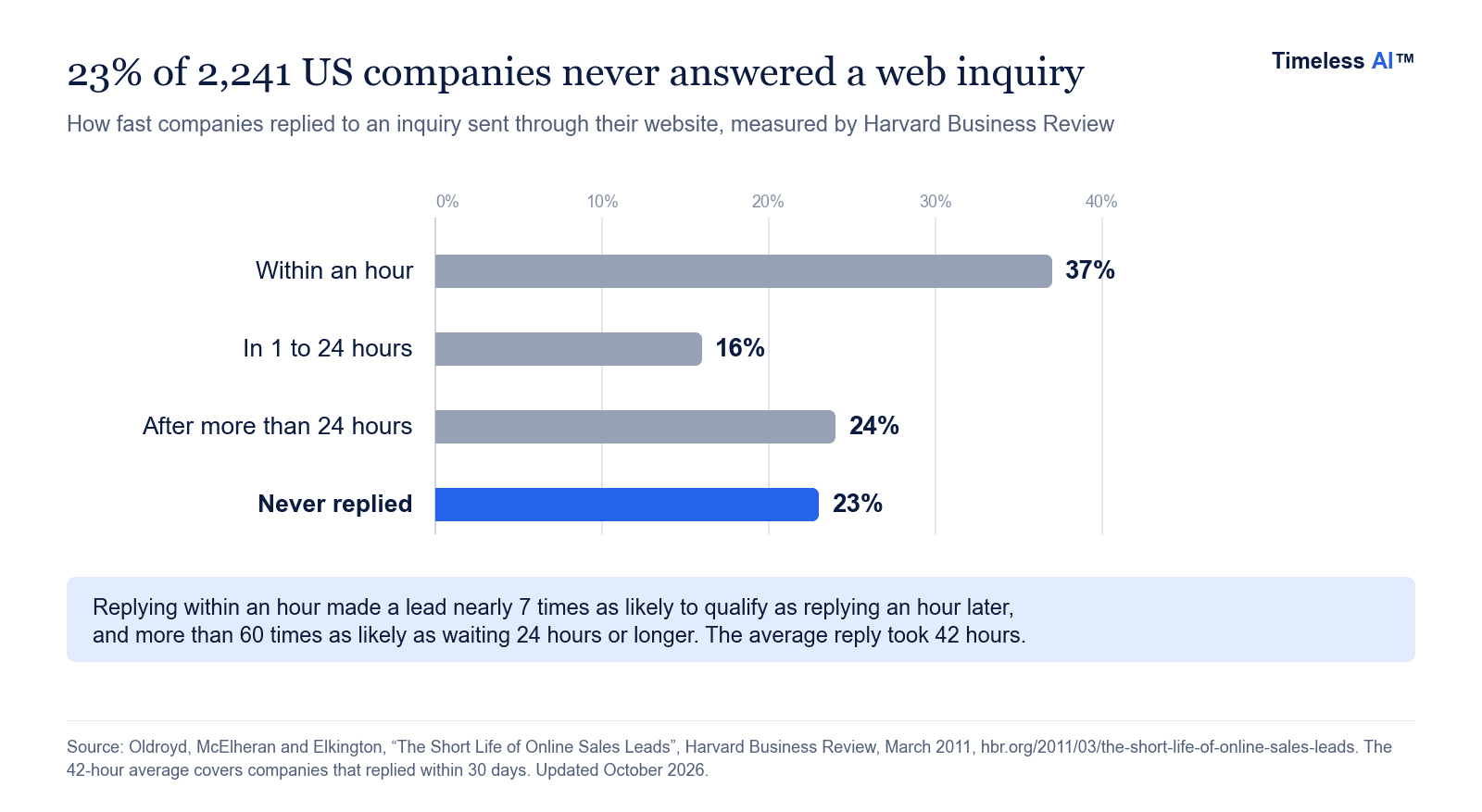
The fastest money in any expert business is the client who was ready to book and never heard back. Harvard Business Review researchers sent a web inquiry to 2,241 US companies and found that only 37% responded within an hour, 23% never responded at all, and the average response among companies that replied within 30 days took 42 hours (Harvard Business Review, March 2011). Companies that replied within an hour were nearly seven times as likely to qualify the lead as companies that replied an hour later, and more than 60 times as likely as companies that waited 24 hours or longer. A solo psychologist in session, a plumber under a sink and a consultant on a flight all answer late by design, which means they lose the most valuable inquiries every week without ever seeing them go.
An AI twin closes that gap, and the people building the market already use twins this way. BBC Future reported in August 2026 that HeyGen co-founder Wayne Liang uses his own AI twin to handle initial business queries, and that the founder David Nussbaum sends his AI double to trade shows to answer questions about him and his business (BBC Future, August 12, 2026). The coaching-clone company BuddyPro says its experts have produced more than $6 million in recurring revenue across more than 150 launched AI twins (BuddyPro, company figures read October 2, 2026). This guide shows how to monetize your expertise with AI through a twin you own, with eight worked examples from the United States, the United Kingdom, Canada, India and South Korea, and every price on the page is in US dollars unless an example says otherwise.
Definitions
AI twin: an AI version of a real person that answers in the first person, in that person's words and voice, on the person's behalf.
Monetizing expertise with AI: earning more from your knowledge and judgment through an AI that answers as you, without adding hours to your working week.
Speed to lead: the time between a prospective client's first question and your first useful answer, the single biggest predictor of whether that person books.
Prequalification: answering a prospect's practical questions about fit, fees, location and timing before a call, so your calendar fills with people who are ready and suited to work with you.
Persona: the private AI version of you that you build on Timeless AI™ by talking about your work, your values and your life.
Executor Lock™: Idy's patent-pending system of named executors, Trusted Contacts, a verified death report and a sealed snapshot of your Persona that can never be changed.
What does it mean to monetize your expertise with AI?
Monetizing your expertise with AI means letting an AI version of you do the parts of your work that depend on your knowledge but not on your presence, so more of your hours go to paid work and more of your prospects become clients. For most experts the ceiling on income is time, because there is a hard limit on how many inquiries you can answer, how many discovery calls you can take and how many clients you can see. An AI twin lifts that ceiling by answering in your words, from your own Persona, to every person who asks, at any hour and in their own language. People hire you for your judgment and your method, so the twin has to carry both faithfully, which is why a twin built from your own memories converts where a generic website chatbot never will.
There are three broad ways experts use AI to earn more, and they are worth very different amounts. The first is using AI to produce your existing work faster, such as course outlines, newsletters and slides, which saves time and sells nothing new. The second is putting a general chatbot over your documents, which answers in a company voice and competes with free assistants that already know general knowledge. The third is an AI twin of you that answers as you, under your name and photo, and moves people to the next step with you, and that is the model this guide covers, because the value comes from your reputation and your availability rather than from the software.
What are the ways to monetize your expertise with AI?
An AI twin of you earns in eight distinct ways, and most experts combine three or four of them. The table lays out each way, how the money arrives, who gains most and which of the twin's three doors carries the work. The doors are your website, your own apps through the API, and the AI assistants people already use, which reach your twin over MCP, the open protocol assistants use to call other services.
Way to earn | How the money arrives | Best for | Doors |
|---|---|---|---|
Turn website visitors into booked clients around the clock | Your twin answers at the moment of interest and sends ready visitors to your booking link | Therapists, clinics, lawyers, advisers, coaches | Website, AI assistants |
Win the after-hours job before a competitor calls back | Visitors at 10 p.m. and on weekends get an answer and a booking request instead of a contact form | Plumbers, electricians, HVAC and every trade | Website |
Prequalify inquiries | Your twin explains fit, fees, service area and minimums, so fewer calls are wasted and more calls close | Consultants, coaches, agencies, specialists | Website, AI assistants |
Buy back your hours | Your twin takes the repeat questions from prospects, clients and staff, so your time goes to billable work | Consultants, founders, CEOs | Website, API |
Raise your prices | Clients who reach you instantly, in your words, value you more, and a premium for availability becomes easy to charge | Coaches, consultants, specialists | Website, API |
Add your twin to a paid product you already sell | Your course, membership or client portal includes your twin through the API, and you keep every dollar the product earns | Course creators, educators, community owners | API |
Get recommended inside AI assistants | When a client asks an AI assistant about you or your field, the assistant can consult your twin directly | Authors, speakers, consultants, niche experts | AI assistants |
Keep the business earning when you step back | Staff, customers and buyers keep getting your answers after you retire, fall ill or die, under the executor you named | Founders, partners, retiring experts | API, website |
Every one of those eight runs on the same twin under one plan. A therapist might use the first, third and fifth, while a founder might use the fourth and eighth. The common thread is that your clients pay you directly, through your own booking, invoicing and payment tools, and Idy takes no share of your fees, so the $59.99 Timeless Pro plan is the only cost.
How does an AI twin turn visitors into booked clients?
An AI twin turns visitors into booked clients by answering the questions that stand between interest and a booking, at the moment the visitor asks, and then handing that visitor straight to your booking link or call-back form. Every visitor sees your name, your photo and a small Timeless AI™ Twin badge, and your twin replies as "I", in your phrasing and in the visitor's own language. When a visitor asks whether a person is typing, your twin says plainly that the visitor is talking with your AI twin, then carries on helping. Your twin answers in your own cloned voice, so a nervous client at midnight hears the calm, specific answer you would give on the phone.
The sequence below is the one that wins the booking. Each step removes a reason to leave, and the last step puts the visitor in your own calendar or inbox with the details already gathered.
Step | What the visitor needs | What your twin does |
|---|---|---|
1. First question | "Do you handle this kind of problem?" | Explains what you do and do not take on, in your words |
2. Fit | "Is this person right for someone like me?" | Describes your approach, your specialties and who you work with best |
3. Practicalities | "What does it cost, where are you, when could we start?" | States the fees, ranges, service area and availability you set |
4. Trust | "Are you licensed, insured, qualified?" | Gives your credentials and policies exactly as you wrote them |
5. Next step | "How do I book?" | Sends the visitor to your booking link, calendar page or call-back form |
6. Follow-up | You need context before you call | You read the full conversation, kept for a year, before you pick up the phone |
You stay in control of every answer. You choose which parts of your life your twin draws on, your work and your values come in by default, and family, health and money stay out unless you add them. Visitors can ask anything, but only you teach your twin, because visitor conversations never become memories, and you can pause any door with one switch.
How much is a faster reply worth?
A faster reply is worth more than almost any other change an expert can make to a business, because the client who books first rarely keeps shopping. The Harvard Business Review audit is the clearest evidence, and the numbers below come straight from it. Read the right-hand column as the gap an AI twin closes for a business that today answers in office hours or by voicemail.
What HBR measured across 2,241 US companies | Result | What a twin changes |
|---|---|---|
Replied to a web inquiry within an hour | 37% | Your twin replies in seconds, every time |
Replied in one to 24 hours | 16% | No visitor waits for office hours |
Took more than 24 hours | 24% | Your twin answers on weekends and holidays |
Never replied at all | 23% | Every visitor gets an answer and a next step |
Average reply among firms that replied within 30 days | 42 hours | Seconds, in your words |
Likelihood of qualifying the lead when replying within an hour, against an hour later | Nearly 7 times as likely | The first answer the prospect gets is yours |
The same, against waiting 24 hours or longer | More than 60 times as likely | The after-hours inquiry stops going to a competitor |
Source: Harvard Business Review, March 2011. The scale of the opportunity is enormous, because most expert businesses are one person. The US Small Business Administration counts 36.2 million small businesses, and 29.8 million of them, 82.3%, have no employees at all (SBA Office of Advocacy, February 2026). In the United Kingdom, 4.3 million of 5.7 million private businesses, 75%, employ nobody besides their owners (UK Business Population Estimates 2025). In every one of those businesses the owner answers every inquiry, makes every sale and does the expert work, and a twin takes the first two of those jobs off the owner's desk.
What can an AI twin of you earn? Eight worked examples
The eight examples below are invented people with real plan prices and stated assumptions, chosen to cover the professions that gain most from a twin. Each one shows what the twin does, the numbers before and after, and the hours or revenue the owner gets back. Your own result depends on your traffic, your prices and how well you teach your twin, and the assumptions are written out so you can swap in your own.
Example | City | What the twin does | Extra revenue a month (stated assumptions) | Hours back a year |
|---|---|---|---|---|
1. Psychologist in solo practice | Seattle | Answers fit, fees, insurance and availability, then links to booking | $5,760 in session fees from each month's extra clients | 36 |
2. Master plumber | Houston | Wins after-hours jobs through his booking link | $2,925 | Not counted |
3. Electrician | Manchester, England | Wins evening and weekend jobs | £1,300 | Not counted |
4. Executive coach | Toronto | Prequalifies discovery calls and supports a higher package price | $4,800 in new packages | 48 |
5. Pricing consultant | New York | Answers repeat questions and screens out poor-fit prospects | $40,000 of billable time recovered a year | 100 |
6. Online course teacher | Columbus, Ohio | Powers a paid "Ask the teacher" tier through the API | $774.91 after card fees and the plan | Not counted |
7. Language tutor | Seoul | Answers visitors in their own language at their own hour | $600 in recurring lessons | Not counted |
8. Software founder | Bengaluru | Answers staff and customers in the founder's words, and keeps answering after the founder | $19,500 of founder time a year | 130 |
1. The psychologist in solo practice in Seattle
This example covers general practice information, not diagnosis or therapy. A Timeless AI™ Twin explains how a practice works and never assesses, diagnoses or treats. If you or someone you know is in crisis, call or text 988 in the US, or your local emergency number.
Dr. Lena Park is a licensed psychologist in solo practice in Seattle, with a self-pay rate of $180 a session and telehealth across Washington. Her website draws 600 visitors a month, and most of them arrive in the evening, when she is with clients or at home. Her twin answers at that moment, explaining who she works with, her approach to anxiety and OCD, her fees and superbills, her current availability and how to book a first consultation. The American Psychological Association's 2025 survey of 1,742 psychologists found that 29% now use AI at least monthly, up from 11% a year earlier, and that 46% have no openings for new patients and 40% keep a waitlist (APA, December 2025), so a twin serves a practice building its caseload and a full practice managing its waitlist alike.
Before her twin, 1.5% of visitors sent an inquiry, which was 9 a month, and two in three became first sessions, so 6 new clients started each month. With her twin answering at the moment of interest, 2.5% of visitors inquire, which is 15 a month, and two in three still book, so 10 new clients start. If each new client averages 8 sessions, by assumption, each month's 4 extra clients bring $5,760 in session fees against $59.99 for Timeless Pro. Her twin's honest answers about fit also replace about 12 short phone calls a month with people whose needs fall outside her practice, at 15 minutes each, which gives her back 36 hours a year. Illinois's 2025 law bars AI from providing therapy while allowing AI for administrative support (Illinois IDFPR, August 4, 2025), and Nevada restricts AI that provides mental health care (WSGR, June 25, 2025), which is exactly the line her twin works on, because the twin handles practice information and the therapy stays with her.
2. The master plumber in Houston
Luis Ortega is a licensed master plumber with two vans in Houston. His website draws 900 visitors a month, and 400 of them arrive after 6 p.m. or on weekends, when a homeowner with water under the sink is contacting several plumbers at once. His twin explains which jobs he takes, the neighborhoods he covers, the price ranges he sets for common jobs, how urgent a leak or a no-hot-water call is, and what to do while waiting, such as closing the main shutoff valve. Every useful conversation ends with his booking link, so the request lands in his own system with the problem already described.
Before his twin, 2% of after-hours visitors filled in his contact form, which was 8 requests a month, and by the next morning half of them had booked someone else, so he reached 4 and won 3. With his twin answering instantly, 4% of after-hours visitors send a booking request, which is 16 a month, and he wins 3 in every 4, or 12 jobs. At an assumed average ticket of $325, the 9 extra jobs bring $2,925 a month against $59.99 for Timeless Pro. US plumbers, pipefitters and steamfitters held 510,600 jobs in 2025 at a median wage of $63,800, with employment projected to grow 7% from 2025 to 2035 (BLS), and the trade owner who answers first takes a growing share of that work.
3. The electrician in Manchester, England
Sam Whitworth is a self-employed electrician in Manchester, and this example uses pounds because he prices in pounds. About 200 of his website visitors each month arrive in the evening or at weekends, asking about consumer unit upgrades, EV charger installations, electrical safety certificates and whether a tripping circuit is urgent. His twin answers in his words, states his registration and insurance, explains his call-out charge, tells visitors when a problem needs an emergency call and sends everyone else to his booking form. He reads the night's conversations over breakfast and starts the day with jobs already described.
Before his twin, 3% of those evening visitors sent a request, which was 6 a month, 3 of them were still free when he called back, and he won 2. With his twin, 5% send a booking request, which is 10 a month, and he wins 7. At an assumed average job of £260, the 5 extra jobs bring £1,300 a month against $59.99 for Timeless Pro. In the United Kingdom, construction has more small businesses than any other sector, at 885,000, and sole proprietorships make up 57% of all private businesses (UK Business Population Estimates 2025), which is why a trade twin is one of the best-value tools a one-person business can buy. For more on twins for the trades, read the full guide to AI for plumbers and electricians.
4. The executive coach in Toronto
Nadia Haddad coaches senior leaders through promotions and board roles, and sells a three-month package. Before her twin she took 20 discovery calls a month at 30 minutes each, and one in four became a client, so 5 clients a month started at $3,000. Her twin now answers every prospect's questions about her method, the leaders she works best with, what a package includes and what it costs before any call is booked. Prospects who are not a fit learn that in a two-minute conversation, and prospects who are a fit arrive at the call ready to start.
She now takes 12 discovery calls a month and half of them become clients, so 6 clients start each month and she saves 4 hours of calls, or 48 hours a year. Her clients also get her frameworks from her twin between sessions, in her words, so she raises the package to $3,300. Six packages at $3,300 bring $19,800 a month against the $15,000 she earned before, which is $4,800 more each month for $59.99 on Timeless Pro. For more on the coaching model, read an AI clone for coaches and creators.
5. The pricing consultant in New York
Ben Adler is an independent pricing consultant in New York who bills $400 an hour and works on projects with a $15,000 minimum. He fields about 30 repeat questions a week from prospects and clients about how he works, what a project includes, how long a pricing review takes and what data to prepare, and each answer costs him about six minutes. His twin answers 70% of them, by assumption, on his website and inside the AI assistants his clients use, which gives him back about 2.1 hours a week. Across 48 working weeks that is about 100 hours a year, or $40,000 of billable time at his rate, against $599 a year on the yearly Timeless Pro plan.
His twin also prequalifies. Prospects learn his minimum engagement and the kind of company he serves before they book a call, so the people who reach his calendar are the ones he can help. For the consulting model in more depth, read an AI clone for consultants.
6. The online course teacher in Columbus, Ohio
Dr. Ana Reyes teaches statistics at a state university and sells an online exam-preparation course on the side. Her course platform connects to her twin through the API, so she adds an "Ask Ana" tier at $29 a month in which members get her explanations of p-values, confidence intervals and regression at 2 a.m. before an exam. Her twin follows the teacher rule that the twin never does assessed work for a student, which is the same answer she gives in office hours. She sells the tier through her own checkout, so the members are her customers and the payments are hers.
With 30 members, the tier brings in $870 a month. At an example card rate of 3% plus $0.30 a payment, her processor's fees come to $35.10, and after Timeless Pro at $59.99 she keeps $774.91 a month, or $9,298.92 a year. Idy takes no share of what her course earns. A video welcome from Persona Video, in her own face and voice, made from a single 30-second recording, greets every new member.
7. The language tutor in Seoul
Ji-woo Park teaches Korean to adults around the world, and her website draws 300 visitors a month from more than 20 countries. Before her twin she answered inquiries in English during Seoul business hours, which meant a learner in Mexico City or Madrid often waited a day for a reply. Her twin now answers each visitor in the visitor's own language, at the visitor's own hour, explaining her method, her levels, her lesson times and her prices, and sends ready learners to book a trial lesson.
Before her twin, 8 visitors a month booked a trial and 4 became regular students. With her twin, 14 book a trial and 7 become students. At an assumed 8 lessons a month at $25 each, the 3 extra students bring $600 a month in recurring lessons, and every student who stays adds to that figure each month.
8. The software founder in Bengaluru
Arjun Mehta founded a 30-person logistics software company in Bengaluru, and his example is the subject of the next section, because a founder's twin earns twice. While he works, the twin gives him back about 130 hours a year that he used to spend answering questions only he could answer. When he steps back, falls ill or dies, the twin keeps the company running on his know-how, under the executor he named.

How does a founder's twin protect the business if the founder steps back or dies?
A founder's twin protects the business by keeping the founder's knowledge answering staff, customers and buyers, and by naming in writing who takes control of that knowledge. Insurers call the danger key-person risk, and a company whose pricing logic, supplier history and customer relationships live in one head carries more of it than any other kind of business. Japan shows the scale of the problem. The country's 2019 Small and Medium Enterprises White Paper estimated that about 1.27 million business owners aged 70 or older would have no successor by 2025, putting about 6.5 million jobs at risk (Wikipedia, Business Succession (Japan)). An eGain and Deloitte report in June 2026 put the value of knowledge at risk from retirements at $6.9 trillion to $9.6 trillion, and found that 92% of organizations fail to capture retirees' knowledge consistently (Quiver Quantitative, June 22, 2026).
Arjun answers about 25 questions a week that nobody else in his company can answer, on how he prices a large contract, what he promised a key customer, which hires he would make and why the product works the way it does. Each answer takes him about 10 minutes, which is a little over four hours a week. His twin, connected to the company's chat tool through the API and to the customer portal, handles 60% of those questions, which gives him back 2.5 hours a week, or 130 hours a year. At an assumed value of $150 an hour, that is $19,500 of founder time a year against $599 for the yearly Timeless Pro plan.
Arjun's founder twin | Per year |
|---|---|
Questions only Arjun can answer (25 a week at 10 minutes) | About 217 hours |
Share his twin answers (60%, by assumption) | 130 hours |
Value of those hours at an assumed $150 an hour | $19,500 |
Timeless Pro, yearly | $599 |
Doors that keep answering after the lock | The staff door, by his choice |
The second payoff matters more. Arjun names his co-founder and his wife as executors, and both accept the Executor Lock™ Agreement while he is alive. He switches on the after-lock setting for the staff door, so if he dies, his twin keeps answering staff from the sealed snapshot of everything he taught while the leadership team runs the transition, and a buyer doing due diligence can still ask how the founder thought about margins and customers. Key-person insurance replaces money, and a founder twin replaces the answers. For the planning side, read business continuity planning, key-person insurance explained, the best succession planning tools, how to capture founder knowledge before it is lost and how to build a digital twin for your business.
How should you price your expertise once your twin is answering for you?
Price your expertise for the value of being reachable, because a client who gets your answer instantly, in your words, values you more than a client who waits two days for a reply. The arithmetic of a twin is simple, since one extra booking usually covers months of the plan. The table shows how many months of Timeless Pro one extra booking covers at common values, and how many bookings cover a full year on the $599 yearly plan.
One extra booking (assumed value) | Months of Timeless Pro covered at $59.99 a month | Bookings that cover a year on the $599 plan |
|---|---|---|
A therapy session at $180 | 3.0 | 4 |
A plumbing job at $325 | 5.4 | 2 |
An electrical job at $300 | 5.0 | 2 |
A consulting hour at $400 | 6.7 | 2 |
A coaching package at $3,300 | 55 | 1 |
A language lesson at $25 | 0.4 | 24 |
Availability is also a reason to charge more. Clients already pay for access to an expert's AI, which Harvard Business School shows with its $699 eight-week program in which founders pitch AI avatars of seven professors (PYMNTS, August 27, 2026), and BuddyPro recommends that its experts charge $1,997 a year for AI coaching subscriptions (BuddyPro). The executive coach in example 4 raised her package by 10% because her clients get her frameworks between sessions. A consultant who answers every prospect in seconds, at any hour, can hold a higher rate in the first conversation, because the prospect has already experienced the service.
What do AI clone platforms charge, and what cut do they take from your income?
AI clone platforms charge in very different ways, and the difference shows up in what you keep. Uare.ai keeps 30% of gross revenue when creators charge visitors on its $199.99 Professional plan, Delphi sets creator payments in a private statement of work, and BuddyPro charges a license plus AI usage per paying user. On Timeless AI™ Twin your clients pay you directly, through your own booking, invoicing and payment tools, so Idy takes no share of your fees. The table uses prices and terms as checked on October 1 and 2, 2026.
Timeless AI™ Twin | Uare.ai | Delphi | BuddyPro | Coachvox AI | Personify | |
|---|---|---|---|---|---|---|
Built for | A professional's twin that answers, books and passes to an executor | Creator and professional chat clones | Creator chat clones | Premium AI coaching subscriptions | Coaching clones | Creator chat clones |
Plan you need | Timeless Pro, $59.99 a month or $599 a year | Professional, $199.99 a month, to charge visitors | Custom "Immortal" tier to charge visitors | $197 a month on annual billing, plus AI usage of about $300 per paying user a year (company estimate) | $83 a month, billed yearly | Pro, $39 a month or $29 a month billed yearly |
Cut of your income | None; clients book and pay you directly | 30% of gross, with processor fees from your share | Private statement of work | No revenue cut; usage fees instead | No cut stated | No fee stated |
Your death in the terms | Section 8 and the Executor Lock™ Agreement | Not mentioned | Not mentioned | Mentioned only in a liability clause | Not mentioned | Published terms cover the marketing website only |
After the owner dies | Each door keeps answering if the owner chose that, under the named executor | AI deleted or de-identified on cancellation | Content deleted on termination unless kept six months | Twin made inaccessible on termination | Accounts can be suspended after six months or more of inactivity | Not covered by the published terms |
Sources: Uare.ai creator terms and pricing; Delphi creator terms and pricing; BuddyPro; Coachvox AI terms; Personify pricing; our Terms. Delphi named its top tier "Immortal", and its terms never mention death. For every platform judged in depth, read the best digital twin apps compared.
Who already earns from a copy of themselves?
Musicians, actors, universities and estates have earned from AI and digital versions of people for years, and the record shows that the person who wrote the terms kept control. The table collects the best-documented cases, from a London arena to a Hollywood studio and a Harvard classroom. Read the last column first, because the answer to who set the terms predicts who kept the value.
Who | What happened | When | Who set the terms |
|---|---|---|---|
ABBA | Digital avatars of the band as they looked in 1979 perform nightly in a purpose-built London arena, for more than four million visitors and over $2 million a week on a reported $175 million budget (Wikipedia) | Since May 27, 2022 | The band, while alive |
Grimes | Invited anyone to make songs with an AI copy of her voice, for a 50/50 split of royalties on successful songs (BBC News) | April 25, 2023 | She did, in public |
Holly Herndon | Built Holly+, a voice model of herself, with a community of stewards who decide which new works made with her voice are sold with her approval (Wikipedia) | 2021 | She did |
James Earl Jones | Signed a deal letting Lucasfilm generate Darth Vader's voice from archival recordings, two years before he died on September 9, 2024 (Wikipedia) | 2022 | He did, in writing |
Reid Hoffman | Released a 14-minute conversation with "Reid AI", a twin trained on two decades of his books, speeches, interviews and podcasts (Popular Science) | April 2024 | He did |
Klarna and Zoom | Chief executives Sebastian Siemiatkowski and Eric Yuan gave investor remarks through AI avatars of themselves in the same week (TechCrunch) | May 2025 | They did |
Khaby Lame | An all-stock deal reported at up to $975 million for rights to an AI twin of the creator (Black Enterprise) | January 2026 | The buyer, under the deal |
Suzanne Somers | An AI twin built after her death from her 27 books and hundreds of interviews, on her own wish, to keep answering her readers (Fox News) | Shown in 2025 | Her wish, carried out by her husband |
Two lessons run through the table. People who set the rules themselves, such as Grimes, Holly Herndon and James Earl Jones, kept control of their likeness and its value. People whose terms were set by a buyer, a school or an estate saw the value flow to whoever held the contract, which is why the expert who builds an owner-held twin today keeps both the income and the decisions. For broader market figures, read creator economy statistics.
What happens to your twin and your business after you die?
Your twin follows the rules you set while you were alive, and Executor Lock™ carries those rules out. An executor or Trusted Contact who accepted the Executor Lock™ Agreement reports your death with evidence, automated analysis and then a person check that evidence, and seven days of cooling-off follow, in which any executor can dispute the report and you can cancel a false report with proof of life. Then your Persona is sealed as a perfect snapshot of everything you taught, and our Terms call the lock permanent and irreversible (section 8.3). Each door you switched on keeps answering from that snapshot, so the customers, staff and students who relied on your knowledge keep getting your answers, under the executor you named.
Your will still governs your estate, so name the same people in your will and tell your lawyer what you set up in the app. In California, a direction given through a service's own online tool can override a contrary direction in a will for digital assets, under the state's version of the Revised Uniform Fiduciary Access to Digital Assets Act (AB 691, approved September 24, 2016). How that rule applies to your twin is a question for your lawyer, and the principle that an in-app setting carries legal weight is already law in many US states. For the ownership question in full, read who owns your AI likeness after you die, and for the executor's role, read how Executor Lock™ works.
Why can only a governed twin keep working after the owner dies?
A twin can only keep working after the owner dies if someone has the authority to keep the twin running and the rules are already written down, and Idy built exactly that before building the twin. Idy, the company behind Timeless AI™, spent its first years on governance, death, privacy and consent, the parts of personal AI that decide whether a twin is an asset or a liability for the people left behind. The result is Executor Lock™, and the technology behind the lock is covered by Idy's 78 patents pending. Those patents pending cover verifying a death before control of a Persona changes hands, handing authority to a named executor and sealing the Persona at that moment, consent and permissions with proof that consent was given, and keeping a Persona the same person when the underlying AI models change.
Other platforms were built for narrower jobs. Video-avatar tools such as Tavus, HeyGen and Synthesia produce marketing, training and support videos, and creator clones such as Delphi and Uare.ai answer an audience while the creator keeps paying. When we read the published terms of nine AI twin and avatar platforms, about 85,000 words in total, not one said what happens to your clone or your account when you die, and five of the nine reserve the right to end accounts for inactivity or lack of use (terms checked October 1, 2026). An account whose owner has died looks exactly like an inactive account, which is why a twin without a succession plan stops working when the owner does. For what each platform's contract says happens to your twin, read the best digital twin apps compared.
Which expertise earns most as an AI twin?
Expertise earns most as a twin when people ask you the same questions repeatedly, when the answers depend on your judgment rather than on general knowledge, and when the person asking is close to a buying decision. A named method, a teaching style people recognize, a license, a service area or a reputation that clients seek out by name all make a twin more valuable. Free assistants already answer general questions, so your twin earns where the answer is specifically yours, such as whether you take a case, how you would approach a negotiation, what a job will roughly cost or why your recipe works.
Durable knowledge matters for the long run too. A lecturer's subject, a founder's operating principles and a cooking school's techniques keep their value for decades, so those doors are natural candidates to leave on after the lock. Fast-moving details, such as a fee schedule or this month's availability, belong on a door you keep current and close at the lock, and the per-door switch lets you make that call door by door. For the profession-by-profession view, read professional AI for founders, CEOs, psychologists and tradespeople.
How do you get your first bookings from your twin?
Your first bookings come from the places where people already look for you, so put your twin there first. Add the website door to the pages that draw the most questions, such as your services, fees and contact pages, link your twin from your email signature and your booking confirmations, and open the MCP door so AI assistants can consult your twin when someone asks about you or your field. Write your booking link, your fees, your service area and your 30 most-asked questions into your Persona in your own words before you switch on a single door.
Read your twin's conversations every week, because the transcripts show you exactly what people ask before they book and where they drop off. Add memories wherever an answer was thinner than the one you would give in person, and tighten the questions that lead to poor-fit inquiries. Persona Video helps too, since a welcome in your own face and voice, made from one 30-second recording, tells new visitors they are getting the real you. For the full build, read how to make an AI version of yourself, and for video, read how to make an AI video of yourself in your own face and voice.
What should you insist on before you build?
Before you build an AI version of your expertise, insist on fidelity, ownership, governance, boundaries and a written plan for your death, because your twin carries your reputation to every client who meets your twin. The checklist below covers the questions to put to any platform and how Timeless AI™ Twin answers each one. A platform that cannot answer all eight in writing is asking you to build an asset the platform controls.
Question to ask any platform | Why the question matters | How Timeless AI™ Twin answers |
|---|---|---|
Does the twin answer from my own words and method? | Clients hire you for your judgment, and a generic summary is worth nothing | Your twin answers from your own Persona, in the first person and in your own voice |
Do I hold the twin, or does the platform or my employer? | Whoever holds the twin sets the terms and takes the upside | You hold your twin, built from your own Persona |
What does the platform take from my income? | A revenue cut grows with your success | Idy takes no share of your fees; the plan is the only cost |
Can I choose what the twin speaks about? | Boundaries protect your reputation and your privacy | You choose categories; family, health and money are never included unless you add them |
Can I read every conversation and pause any door? | You need to see what your twin says in your name | Every conversation for a year, and one switch per door |
Does the twin disclose that the twin is an AI? | Disclosure laws now apply in the EU, South Korea, India and New York | A badge on every chat and a truthful one-line answer |
What happens if my account goes quiet? | Many platforms end inactive accounts | No inactivity clause in our Terms; unpaid doors pause and nothing is deleted |
What happens to the twin when I die? | Without a plan, the platform decides by default | Executor Lock™, your after-lock choice per door, your named executor |
Every answer in the right-hand column is written into the product or the Terms, so you can check each one before you build. For the law country by country, read how the law treats a person's likeness, and for the business ownership question, read who owns an AI clone made for your business.
Why should you start narrow, then expand?
The most reliable way to monetize expertise with AI is to start with the slice of your work closest to a booking and capture that slice deeply in your own words. Pick the 30 questions prospects ask before they hire you, answer each one the way you would on the phone, add your booking link, and open a single door on the page that gets the most traffic. Once your twin sounds like you and the bookings start arriving, add the next slice of your method, the next door and the next audience.
Starting narrow protects your reputation, because the first visitors meet a twin that knows one subject thoroughly. Starting narrow also makes the results easy to measure, since you can compare inquiries and bookings for the month before and the month after your twin went live. A twin built this way grows with your work, and every slice you add makes the twin more valuable to your clients today and to the people who rely on your knowledge after you.
How do you license your expertise as an AI?
Licensing your expertise as an AI means letting an organization use your twin to answer its people, on terms you set and can withdraw. A firm might want your judgment available to its staff, an association might want your twin answering its members, and a university might want your twin inside a course. You agree the scope and the fee directly with the organization, open an API door for that organization with its own secret key, and pause or remove that door whenever the arrangement ends. The organization pays you under your own agreement, and Idy takes no share of the fee.
Licensing only works when you hold the twin, because you cannot license what someone else owns, and a license you cannot enforce or revoke is a giveaway. Ownership and governance come first for that reason. Organizations that want twins for their faculty, partners or members can start a conversation through the organizations line below, and every twin built that way still belongs to the professional and still follows the professional's own Executor Lock™.
So how do you monetize your expertise with AI this year?
Build a twin of you from your own Persona, teach your twin the questions that come before a booking, put your twin on your website and inside the AI assistants your clients use, and send every ready visitor to your booking link. The eight examples show the money arriving in several forms, as more booked clients, more after-hours jobs, better-fit discovery calls, higher prices, hours of billable time recovered and a paid product of your own. Name your executor while you set up, and your twin keeps your business answering through any handover. One extra booking a month covers the plan in most professions, and the free build lets you hear your twin in your own words before you spend anything.
Frequently asked questions
How do you monetize expertise with AI?+
You turn your knowledge, method and voice into an AI twin you own and put your twin where clients look for you. Your twin answers prospects at any hour, qualifies them and sends ready visitors to your booking link, and you can add your twin to a course or membership you already sell through the API. Most experts start with their website and add AI assistants and their own apps later.
Can I make money from an AI twin of myself?+
Yes. Your twin earns by turning website visitors into booked clients around the clock, winning after-hours work before competitors reply, saving the hours you spend on repeat questions and powering paid products you sell yourself. In the examples on this page, one psychologist adds four new clients a month and one plumber adds nine jobs a month, on the $59.99 Timeless Pro plan.
How much can an AI twin of me earn?+
That depends on your traffic and your prices, and the eight worked examples show the range, from $600 a month in extra lessons for a language tutor to $4,800 a month in new coaching packages and $40,000 a year of recovered billable time for a consultant. In most professions one extra booking a month covers the plan. The assumptions behind every example are written out so you can run your own numbers.
Does Idy take a cut of my income?+
No. Your clients book and pay you directly through your own booking, invoicing and payment tools, and Idy charges only the Timeless Pro plan at $59.99 a month or $599 a year. By comparison, Uare.ai keeps 30% of gross revenue when creators charge visitors on its $199.99 Professional plan (terms checked October 1, 2026).
Can a psychologist or therapist use an AI twin to get clients?+
Yes, for practice information. A psychologist's twin answers prospective clients about fit, specialties, fees, insurance and availability, and moves good matches to booking, while the therapy stays with the psychologist. Illinois's 2025 law allows AI for administrative support, which is exactly the work the twin does.
Can a plumber or electrician use an AI twin to win more jobs?+
Yes. A trade twin on your website answers every visitor at night and on weekends, in your words, about the jobs you take, your service area, rough price ranges and urgency, and sends each one to your booking link or call-back form. Harvard Business Review found that replying within an hour made an inquiry nearly seven times as likely to qualify.
Will my twin actually reflect my real method?+
Yes, if you build your twin from your real reasoning in your own words. Your twin answers from your own Persona in the first person, and reading your twin's conversations each week shows you where to add memories so the answers match the ones you give in person. Depth of capture is what makes a twin convert.
Do I own the AI version of my expertise?+
Yes. Your twin is built from your own Persona, you hold the account, and you decide what your twin covers and who can reach your twin on which door. Executor Lock™ then decides, by your rules, who takes over when you die.
Can I control what my twin speaks about?+
Yes. You choose the job your twin does and the parts of your life your twin draws on, and family, health and money are never included unless you add them. You can read every conversation and pause any door with one switch.
Is there a free way to start?+
Yes. You can build your Persona free with 25 memories and no card, and your first Persona Video is free too. Timeless Pro at $59.99 a month, or $599 a year, switches on your twin across your website, your apps and AI assistants when you are ready.
What happens to my twin and my business if I die?+
Executor Lock™ hands control to the executor you named after a verified report and a seven-day cooling-off, and seals your Persona exactly as you left your Persona. Each door you switched on keeps answering from that sealed snapshot, so your staff and clients keep your answers through the transition. Name the same people in your will so your estate plan and your settings agree.
Why does Idy have 78 patents pending?+
Idy built governance, death, privacy and consent before the twin, because a twin that works for a business has to answer who controls the twin, who sees what and who takes over. The 78 patents pending cover that work, including verified handovers to a named executor and the sealed snapshot behind Executor Lock™. That foundation is why a Timeless AI™ Twin can keep your business answering after you step back.
How we researched this page
We read the Harvard Business Review lead-response study, the American Psychological Association's 2025 Practitioner Pulse Survey, US Bureau of Labor Statistics occupational data, the SBA Office of Advocacy's 2026 small business figures, the UK's 2025 business population estimates, BBC Future's reporting on executive AI clones, the creator and monetization terms of Uare.ai, Delphi, BuddyPro, Coachvox AI and Personify, and the full terms of nine AI twin and avatar platforms (about 85,000 words, checked October 1, 2026). Every outside fact links to its source and date.
Written and reviewed by Chris Williams, CEO & Founder, Timeless AI™
Published 29 June 2026 · Last updated 3 October 2026
Chris Williams is the founder and CEO of IDY Pty Ltd, the company behind Timeless AI and its sibling brand Afterlife AI. He writes about personal AI, digital identity, and how people can build a living AI self they own and govern.